

The Sunken Basilica of Saint Neophytos
3 december, 2025
After an eventful day in Iznik, one of our last visits was to the Basilica of Saint Neophytos. In 2014, the Bursa Metropolitan Municipality took pictures of the Iznik River, where archaeologist Mustafa Sahin discovered an underwater basilica. The Basilica is believed to have been built in the 4th century AD. When the archaeologist discovered the basilica, it was about two meters underwater and 50 meters from the shore. The Archaeological Institute of America selected the basilica as one of the world’s top 10 archaeological discoveries in 2014. In 2015, Turkish archaeologists began underwater excavations, during which they found damaged tombs and skeletons. The archaeologists restored the tombs and skeletons to their original condition with tiles after documenting and photographing them. Several archaeologists consider the basilica to be a prime example of early Christian architecture.
Upon discovering the basilica, archaeologists began to ponder three matters regarding its history: First, is this the lost Temple of Apollo of Roman Emperor Commodus? Was this the lost Church of Saint Neophtyos? And was the First Council of Nicaea held in this building? However, the church ruins date from the late fourth century, indicating that the council could not have been held at this basilica. Some speculate that another structure stood at this location before the basilica was built, but there is no explicit evidence to support this theory. No one can say for certain where the First Council of Nicaea was held.
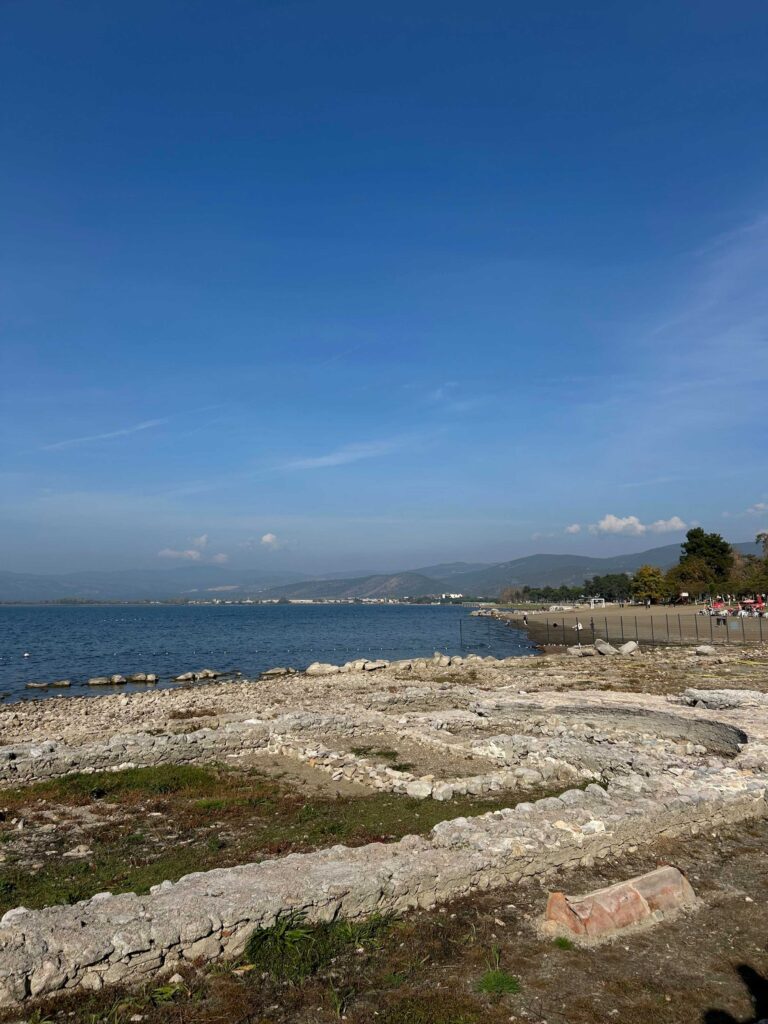
Picture by Siri Mathisen.
When we visited the Basilica of Iznik, a new ramp had just opened, leading straight to the front of the building. The intention was to open the cultural landscape of Iznik and create an important attraction for tourists and other visitors. Perhaps the intention was also to incorporate Iznik and the basilica into Christian pilgrimage and religious tourism. For the most part, one could only see the outlines and stones remaining from the basilica, as well as several tombs. From these outlines, one could easily envision the original structure.
Not long after our field research, Pope Leo XIV visited the basilica on November 28th to celebrate the 1700th anniversary of the First Council. At the basilica, Pope Leo XVI took part in an ecumenical prayer meeting, where he spoke extensively about the Nicene Creed of Christ’s divinity unites all Christians into a deep bond, unity and universal brotherhood.
Just a few years ago, the basilica was underwater, but today, the water level has receded. Many archaeologists question how the water level could have receded. Did it happen naturally, or was it done to cleanse up the basilica in preparation for Pope Leo XIV visit to Iznik? Before visiting the basilica, I thought I would see an underwater basilica. However, it was more exciting to admire the details and view up close.
Visiting the Basilica of Saint Neophytos gave me insight into early Christian history and sparked my interest in reading more about the basilica and Iznik. Hopefully, Pope Leo XIV’s visit to Iznik will bring more attention to the basilica and its history and significance.
Siri Mathisen
The theological course ”Interreligious Relations in Istanbul and Beyond: The role of Religion in Society, State and Secularism” is a thematic course organized by the theological subjects at Åbo Akademi University during the fall semester 2025 and culminated in a study trip to Istanbul from 6–16 November. The course is conducted in close collaboration with the Swedish Research Institute in Istanbul (SRII) and with the Finnish Institute in the Middle East (FIME). This blog text is the second of eight blog texts to present reflections of the study trip.