
Throughout the course, the focus has been on interreligious interactions and dialogue. We discussed how history has affected us, how doctrine written in a different society affects us in a more secular and postmodern society, and how this understanding impacts interreligious dialogue.
Languages play a significant role in our surroundings, culture, and life. They take many forms, such as art, symbols, body language, and spoken or written words. By studying language, one can learn a great deal about cultural trends, political beliefs, values, and society. Understanding language allows us to experience our surroundings and the world and make sense of it all. Therefore, understanding the language is of the utmost importance.
This is something we do in any research or thesis: we define the words we use and explain how they should be understood.
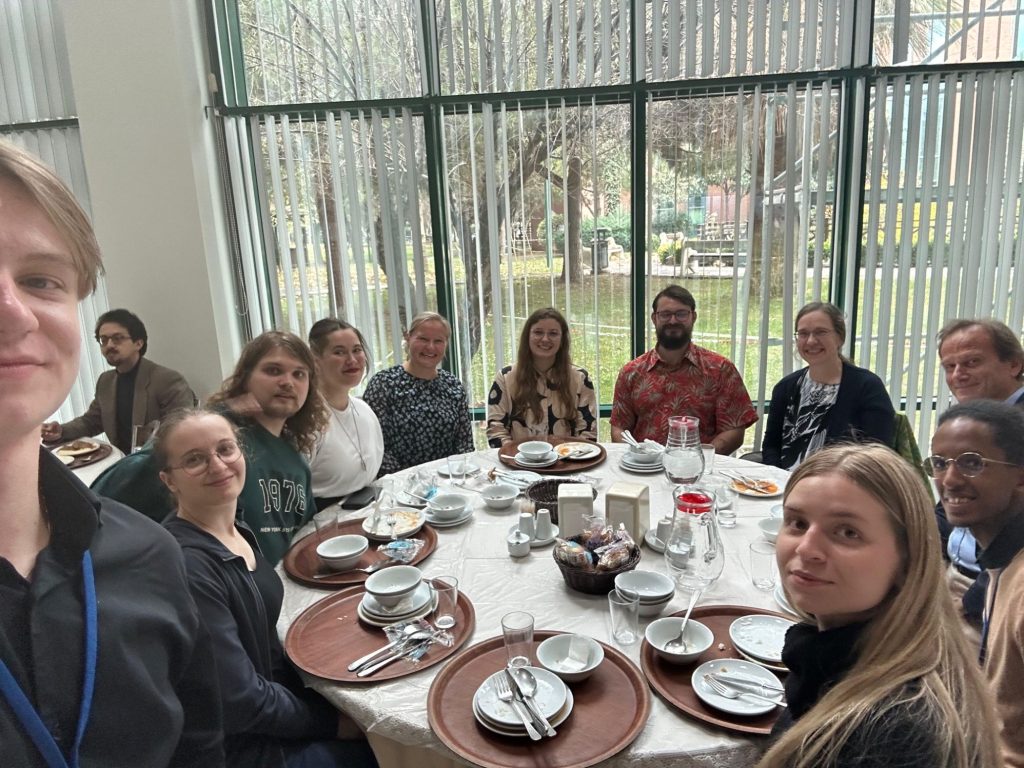
Visit at the İSAM (Centre for Islamic Studies), where we discussed secularism. The meal symbolized interreligious dialogue, showing that despite our different views, we can still sit down at the same table. Photo by Salomon Backlund.
During our visit to İSAM (Centre for Islamic Studies), we realized that our understanding of the meaning of words differs from one another. During a conversation with representatives, we discussed secularism and how we understand the term ”secular.”
Since the time of Kemal Atatürk, the Turkish constitution has defined Turkey as a secular state. However, the definition of secularism seems to have changed over time. During Atatürk’s regime, politics were strictly separated from religion, even resulting in the closure of religious schools. Nowadays, the constitution defines Turkey as a secular state that includes protections for religious freedom. However, the modern Turkish state also enforces laws that restrict religious freedom and control religious activities, e.g., the ban on religious activities outside dedicated buildings and the state’s control over permits for such buildings.
The main question discussed was how a secular state can have such a prominent influence from one specific religion. Calls to prayer are a prime example, as is the number of schools dedicated to Islamic studies.
According to the professor we met, the word ”secular” could be defined as a religion so deeply rooted in the state that it is evident throughout society.
Turkey has become so intertwined with the Islamic faith that it has become increasingly difficult to distinguish where one ends and the other begins. In a sense, it could be said that to be Turkish is to be Muslim. However, not everyone shares this view.
From a Western understanding of secularism, this can be difficult to grasp. Western secularism has often positioned itself as the opposite of religious belief. It has relied on philosophy and science, working to dissociate itself from religion.
The professor described Islam as a worldly and secular religion. He explained how Islam impacts every aspect of society—morally, politically, and spiritually—and concluded that it is a secular faith in a secular state.
He continued to explain how Christianity was considered the opposite of a secular faith, thus making it non-secular. According to him, the reason Christianity was not considered secular was its focus on spirituality. One justification for this would be the Kingdom of God, which is not situated in this world.
This view of secularism also impacts how religious freedom is understood. In Finland, we do not have a state religion, even though Christianity is the predominant faith. We value religious freedom highly. To us, religious freedom means the freedom to choose which, if any, faith one wants to belong to, and the state will not interfere with that freedom. Turkey, on the other hand, also professes religious freedom but holds a completely different view of its contents. The fusion of state and religion creates an interesting context for religious freedom.
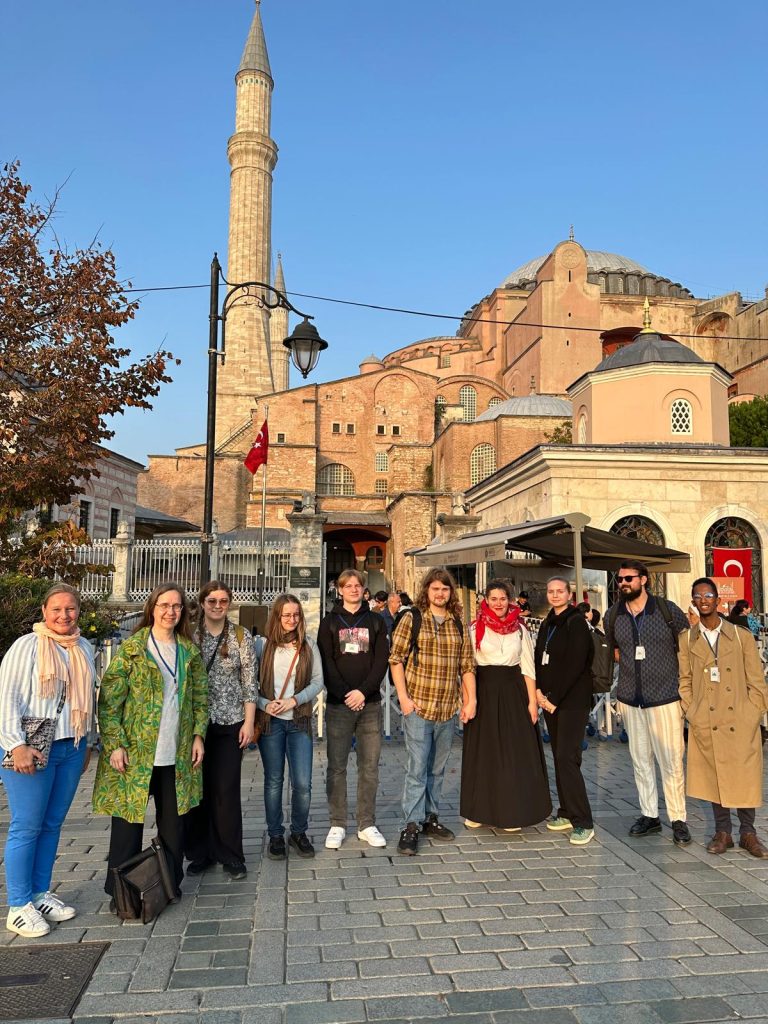
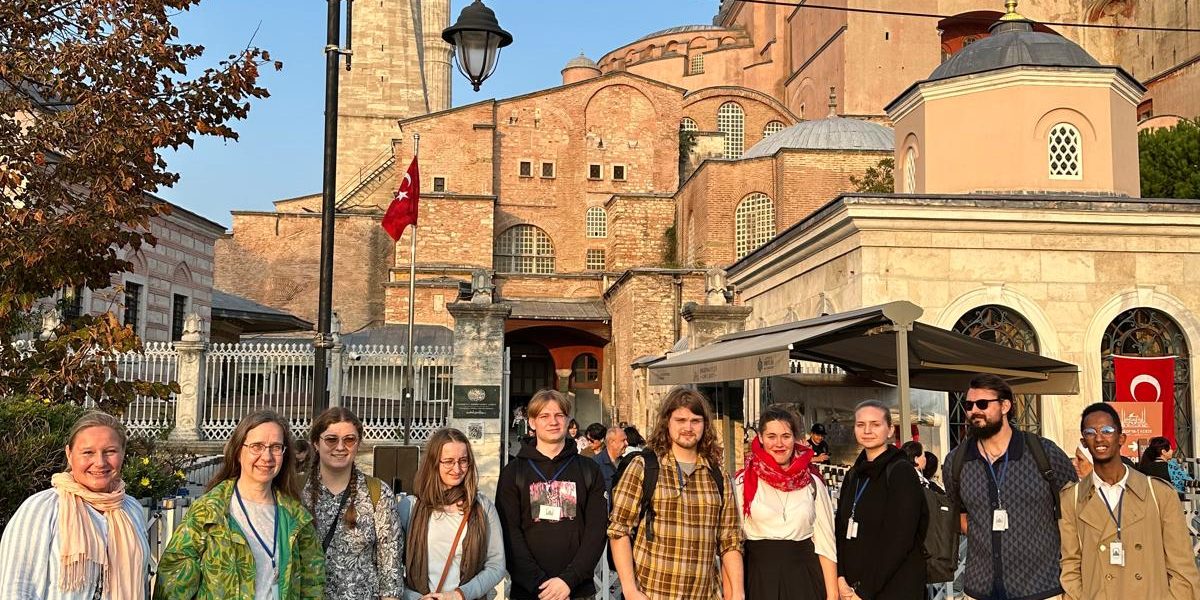
The group is outside of Hagia Sophia, where Christianity and Islam meet. Today, Hagia Sophia is a mosque, but traces of Christianity remain inside.
In conclusion, we must define the words we use and express our understanding of them to convey meaning that can be understood by someone from a different context. Language defines us as humans, and it is through language that we can express our thoughts. However, language cannot be understood unless we first understand the words we use.
Mona Nurmi
The theological course ”Interreligious Relations in Istanbul and Beyond: The role of Religion in Society, State and Secularism” is a thematic course organized by the theological subjects at Åbo Akademi University during the fall semester 2025 and culminated in a study trip to Istanbul from 6–16 November. The course is conducted in close collaboration with the Swedish Research Institute in Istanbul (SRII) and with the Finnish Institute in the Middle East (FIME). This blog text is the last of eight blog texts to present reflections of the study trip.
When visiting the modern and bustling district of Kadiköy, it is difficult to imagine it having any connection to the ancient city of Chalcedon. One of the first sights we saw when we visited on 10 November was a Starbucks, quickly followed by streets where anyone looking for anime and band merchandise, alternative clothing or regular souvenirs is bound to find something interesting. However, if you are looking for anything related to Chalcedon, you will quickly realise that absolutely nothing from that time remains on site.
For centuries, theologians have reflected on the Great Council of Chalcedon, which convened in 451 AD at what was then a major centre of Christian life. Yet hardly any traces of this period remain, as the majority of structures have been lost to time and the rest have been relocated to the Istanbul Archaeological Museum. Without new archaeological findings, the location of important structures will forever remain a mystery.
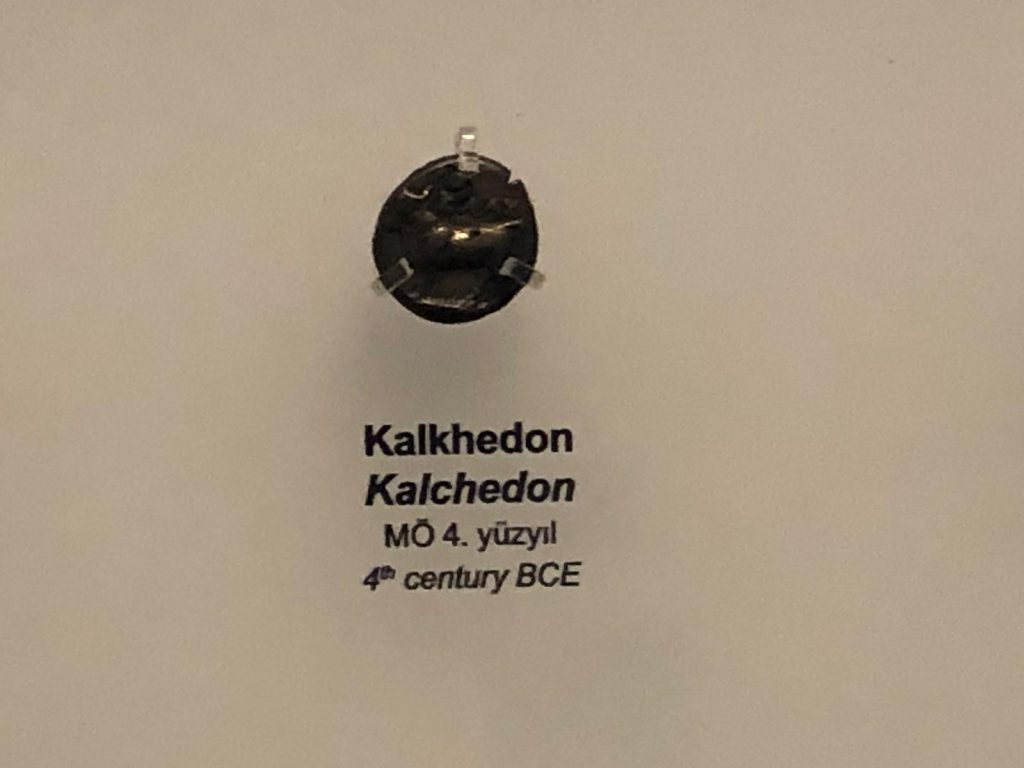
A coin from Chalcedon displayed in the Istanbul Archaeological Museum. Photo by Laura Wickström.
From a theologian’s perspective, one of the most notable historical sites is the martyr shrine and church dedicated to St. Euphemia, the virgin martyr who was killed on the site in 330 AD. The importance of this site is further elevated by the fact that the famous council is said to have taken place in the church itself. Although almost everything about the council has long been erased, the veneration of St Euphemia in the area has continued, with many churches dedicated to her throughout history. One of these remains standing and is still in active use today.
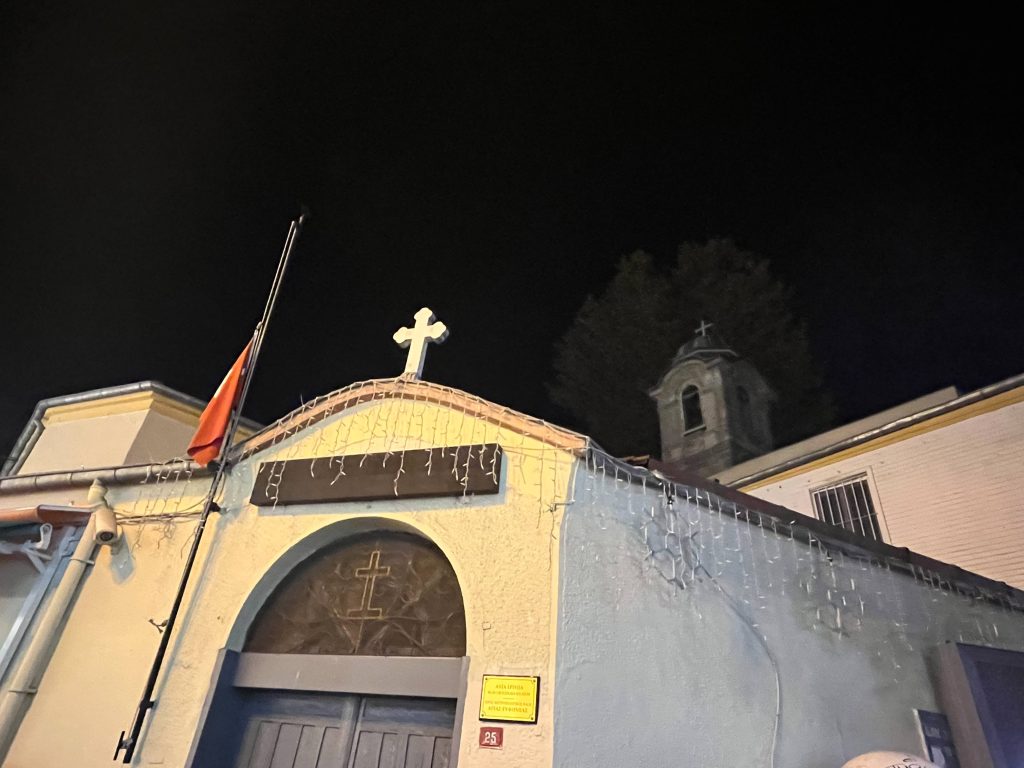
The extant church dedicated to St Euphemia. Photo by Amelie Palonen.
Many days had passed since our initial visit to Kadiköy. I thought it would be our only visit, but then we received a pleasant last-minute surprise: the opportunity to visit the Catholic Tubini Chapel, also located in Kadiköy. There, we met Pr. Bahadır Argönüla, who leads a small Lutheran congregation that usually gathers there. Our visit coincided with the preparations for the Sunday mass the following day, which was expected to be a small, intimate gathering of around ten people. Unfortunately, we had to miss it because of our scheduled departure back home.
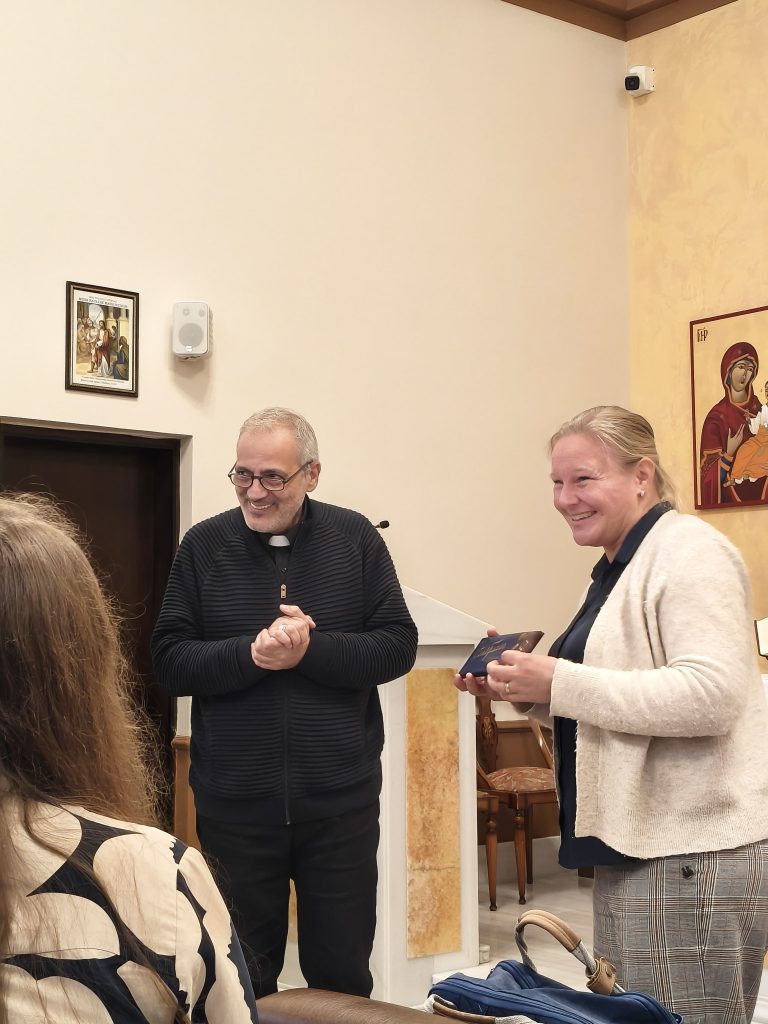
Laura Wickström gifting chocolates to Pr. Bahadır Argönüla. Photo by Mezmur Holmström.
Despite the inevitable changes that over 1,500 years will bring to the area, the Christian spirit has remained and persisted to this day, albeit only in spirit. Although the many mysteries surrounding the city once known as Chalcedon may forever be lost to the tides of history, the prospect of future discoveries keeps me keenly interested in this place I have read so much about.
Amelie Palonen
The theological course ”Interreligious Relations in Istanbul and Beyond: The role of Religion in Society, State and Secularism” is a thematic course organized by the theological subjects at Åbo Akademi University during the fall semester 2025 and culminated in a study trip to Istanbul from 6–16 November. The course is conducted in close collaboration with the Swedish Research Institute in Istanbul (SRII) and with the Finnish Institute in the Middle East (FIME). This blog text is the seventh of eight blog texts to present reflections of the study trip.
What comes to mind when you think of a liturgical language? Latin? Sanskrit? Perhaps classical Arabic? The following blog post is dedicated to the intriguing and mystical language of Ladino.
Ladino is a spoken language within the global Sephardic community. The Sephardic community consists of Jews who lived in the Iberian Peninsula during the Middle Ages. In 1492, Spain expelled its Jews, and Portugal followed suit in 1497. These expulsions shattered the Iberian Jewish communities, forcing them to resettle around the Mediterranean. One surprising destination was the Ottoman Empire. To the modern European, the concept of Sharia law evokes images of tyranny against non-Muslims. However, this was preferable for 16th-century Jews living in a continent ravaged by religious wars and inquisitions. The Balkans and Asia Minor became central hubs for the Sephardic community until the early 20th century.

Visit to the Sephardic synagogue. Photo by Alexander Renqvist.
The language of the Sephardic community has many names. Some of these names include Judeo-Spanish, Sephardic, Judesmo, and Ladino. Ladino is unique as a language. It is a Romance language, like its much larger siblings Spanish, French, and Italian. Many of the words in Ladino are archaic. The expulsion caused Ladino speakers to become isolated from the rest of the Spanish-speaking world. This is why linguists point out that Ladino is more closely related to medieval Castilian than to contemporary Spanish. An example of this is the word for ”son.” The Latin word for son is filius. In modern Spanish, it is ”hijo.” In Ladino, the word for ”son” is fijo, which has undergone fewer phonological changes than its Spanish counterpart. Of course, Ladino does not consist only of archaic Spanish; it has also been influenced by neighboring languages with which it interacted in the Balkans, such as Greek, Turkish, and Bulgarian.
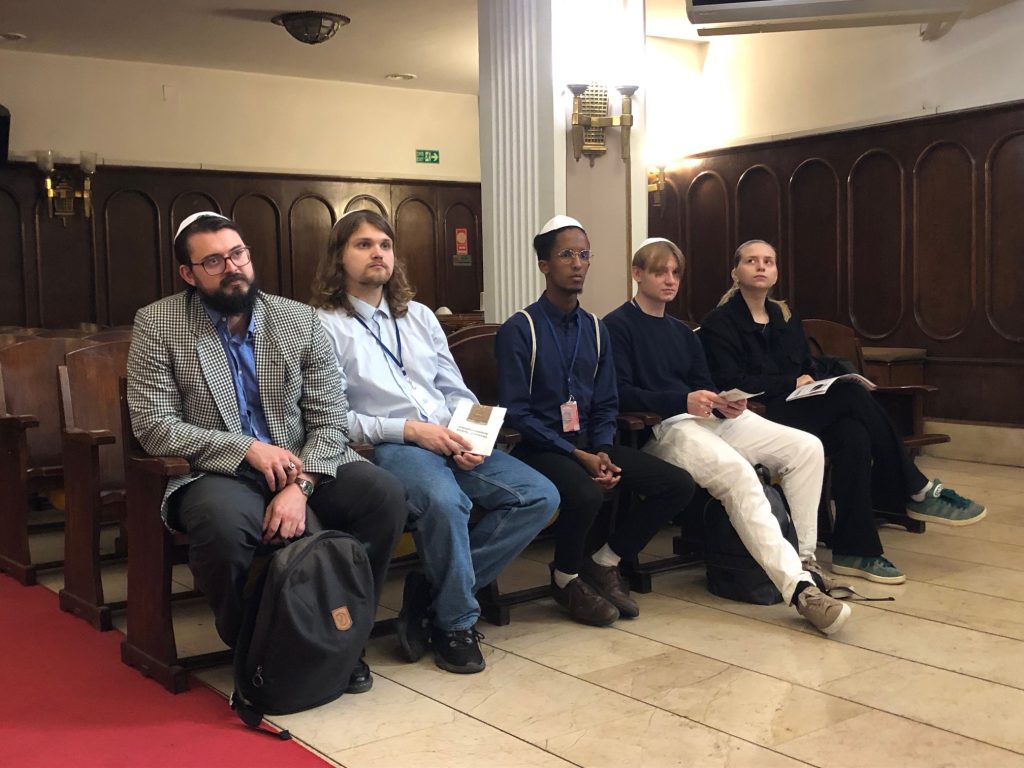
The students are listening attentively to the presentation on the synagogue given by the director and curator of the Jewish Museum, Mrs. Nisya Allovi. From left to right in the picture are Jonathan Stipesevic, Alexander Renqvist, Mezmur Holmström, Salomon Backlund, and Siri Mathisen. Photo by Laura Wickström.
The creation of the State of Israel forever changed the demographics of the global Jewish diaspora. The emigration of Jews from the Balkans severely decreased the number of Ladino speakers. The revival of Modern Hebrew posed a challenge to spoken Jewish languages, such as Ladino and Ashkenazi.
To this day, Ladino is rarely spoken as a first language by its speakers. It is more frequently used by older generations. Nevertheless, it continues to have an influence in Sephardic synagogues across the Mediterranean.
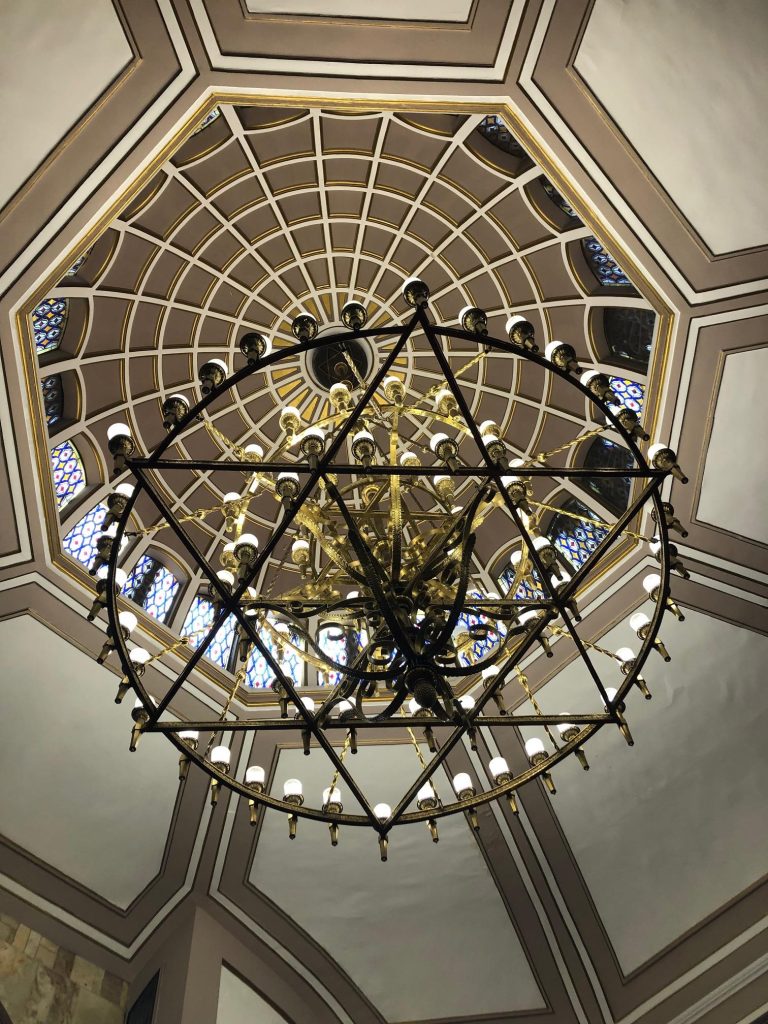
The beautiful chandelier in the Sephardic synagogue.
The Sephardic community preserves Ladino as a liturgical language. It is used in hymns, prayers, family stories, lullabies, and Torah translations. One famous use of Ladino among the Sephardic community is its proverbs. Below, I have written down my favorite Ladino proverbs with English translations.
He who sells the sun must buy candles. Quien vende el sol, merca la candela.
If you love a rose, you must ignore the thorns. Quien quere á la rosa, non mire al espino
Better a donkey that carries me than a horse that throws me. Mas vale un asno que me lleva, que un caballo que me echa.
A sweet mouth opens iron doors. Boca dulce abre puertas de hiero.
The camel can see others’ humped backs, and not his own. El gamello vee solo la corcova de otros, y no la suya propia.
Seeing me is a pleasure; having me is a tragedy. Quien mi vee mi goza, quien mi tiene mi llora.
Proverbs offer a glimpse into the culture, humor, and common wisdom of an endangered language. If you enjoy these proverbs and would like to read more, click on this link.
Alexander Renqvist
The theological course ”Interreligious Relations in Istanbul and Beyond: The role of Religion in Society, State and Secularism” is a thematic course organized by the theological subjects at Åbo Akademi University during the fall semester 2025 and culminated in a study trip to Istanbul from 6–16 November. The course is conducted in close collaboration with the Swedish Research Institute in Istanbul (SRII) and with the Finnish Institute in the Middle East (FIME). This blog text is the sixth of eight blog texts to present reflections of the study trip.
What is the place of religion in a secular society? How should we understand secularism? Can there be peace among people with different beliefs? Do we need to establish common ground before we can discuss anything? Is it necessary to agree in order to have a fruitful dialogue? Who dictates the course of the state? Whose history and culture should be preserved?
We looked for answers to those and other questions during the course Interreligious Relations in Istanbul and Beyond: The Role of Religion in Society, State, and Secularism. As part of the coursework, we went on a study trip to Istanbul (Constantinople) and Iznik (Nicaea), where we looked for marks left by the Council of Nicaea (325). One of the most anticipated destinations for me was Hagia Sophia.
The Byzantine building in the heart of Istanbul is one of the oldest and best-preserved places of worship from that time. Hagia Sophia (Holy Wisdom), built 532-537, was not the first Christian church built in that spot. The first church, inaugurated in 360, burned down in 404. The second church, inaugurated in 415, burned down in 532. One could joke that the third time was the charm, as the building ordered by emperor Justinian stands there almost intact to this day. In 558 an earthquake caused the dome to collapse, but since then no major repairs were needed.
Even though Hagia Sophia became a place of contest between different religious groups, and mirrored the political situation of the city, it was never destroyed, only adapted to its new functions. The originally Orthodox church was looted during the Fourth Crusade and occupied by the Catholics between 1204 and 1261. After Constantinopole was conquered by the Ottomans in 1452, Hagia Sophia was converted into a mosque in 1453. It served as a mosque until 1934, when Atatürk turned it into museum. For over 80 years it was open to the public to display the different functions of the building, and its rich history. Unfortunately for the tourists, it was converted back into a mosque in 2020, and most of the building is no longer available to the public.

Mosaic of the Virgin Mary and baby Jesus. Picture by Emilia Plichta.
The main floor is closed off to visitors and can only be glanced at from the gallery. I was quite disappointed seeing that I would not be able to experience the grandiosity of Hagia Sophia standing under the fifty-five meters high dome. I felt unwelcome in the building, given access to only a fraction of the spaces. The Christian symbols, albeit not destroyed, were partially hidden and noticeable only from certain angles, like in the case of the mosaic of the Virgin Mary in the half-dome of the apse.

The dome of Hagia Sophia. Picture by Emilia Plichta.
I was surprised to learn that there is some evidence that there is a mosaic of Christ under the inscription from the Koran in the dome. It begs the question whether it should be restored because of its historical value for Christians. Hagia Sophia was originally built as an Orthodox Church and was used as a Christian temple for over nine hundred years. But can one erase almost five hundred years of the history of this building being a Mosque to preserve the early Christian history of the place? Making it a museum was a way of dealing with this dual nature of the building. However, with the recent developments of converting it back to a mosque, the Christian past of the building is somewhat put aside. The building is a cultural heritage for many different groups of peoples… So should that be reflected in the policies of its use?
Emilia Plichta
The dates etc. are taken from the book ”Hagia Sofia and Chora” by Kilickaya Ali.
The theological course ”Interreligious Relations in Istanbul and Beyond: The role of Religion in Society, State and Secularism” is a thematic course organized by the theological subjects at Åbo Akademi University during the fall semester 2025 and culminated in a study trip to Istanbul from 6–16 November. The course is conducted in close collaboration with the Swedish Research Institute in Istanbul (SRII) and with the Finnish Institute in the Middle East (FIME). This blog text is the fifth of eight blog texts to present reflections of the study trip.
Our journey to Iznik began in Istanbul on November 8, 2025. We boarded a ferry and then a bus for a two-hour ride to our destination. The scent of morning coffee and the beautiful sunrise fueled our excitement as we awaited what was to come. Our first stop was the ”Hagia Sophia Iznik” mosque (picture above). This structure was likely rebuilt around the 600s, so the original church was probably built around the 4th century. After the Ottoman conquest, the church was converted into a mosque in 1331. Upon entering the mosque and walking to the far wall, one could see the icon paintings from the church era. The images were somewhat unclear since the paint had faded over time.
It was interesting to see the Hagia Sophia Iznik. One can see the division of the building: the old part was a church, and the new part is a mosque. The old part was a church, and the new part is a mosque. By this, I mean that the building still bears traces of its past. The ”tracks” I refer to are the icon paintings and the apse, as mentioned before. In traditional churches, the apse is usually the innermost section where the altar is located, and this section remained intact.
The city of İznik has deep roots in the pottery industry. It is well known worldwide for its famous ”Iznik tiles.” These tiles are best known for their use in mosques, such as the Blue Mosque. Iznik pottery is unique because of its fine quality. Iznik pottery contains around 80-90% quartz, and its most recognizable colors are: Cobalt blue, emerald green, turquoise, and a distinctive red.

Roman theater in Iznik. Picture by Salomon Backlund.
Later in the day, we left to visit a Roman theater. Gladiators once battled in this very location. Constructed around the 2nd century, the theater is estimated to have held 10,000 people. Upon entering this historical site, it’s clear that the structure has many stories to tell. During the fifth century, the theater was used for religious purposes, which is believed to have lasted until the sixth century.
Our journey to Iznik was coming to an end, so we boarded the bus and ferry back to Istanbul once more. I believe it’s safe to say that, as a group, we all enjoyed our day in Iznik and are happy to have made memories there.
Also, we must mention the significant event that occurred in Iznik 1,700 years ago: the Council of Nicaea in 325. It is uncertain where the Council of Nicaea took place in 325; thus, it is known only that it was held. At the council, matters of faith were discussed, and the Nicaean
creed was formulated. The main topic of discussion was the teachings of Arianism, which were later declared heretical.
Iznik is a city rich in culture and history that welcomes visitors and those who seek knowledge of its past.
Salomon Backlund
The theological course ”Interreligious Relations in Istanbul and Beyond: The role of Religion in Society, State and Secularism” is a thematic course organized by the theological subjects at Åbo Akademi University during the fall semester 2025 and culminated in a study trip to Istanbul from 6–16 November. The course is conducted in close collaboration with the Swedish Research Institute in Istanbul (SRII) and with the Finnish Institute in the Middle East (FIME). This blog text is the fourth of eight blog texts to present reflections of the study trip.
While visiting Turkey and some of its most important historical sites from a religious perspective, we stood with many different people who were all pursuing the one God under their own dome.
We discussed and learned about the pursuit of God in Islam, Judaism, and Christianity. The question slowly arose: All three religions proclaim the common belief that the God of Abraham is the one true God. Could this be true? Could the God of Abraham be something that all three religions have in common? Each religion claims that there is only one God and one right way to praise Him and be a true servant of Him (orthodoxy, ahl al-Sunna wa-l-Jama’a1). Considering that the orthodox teachings of these three belief systems are so different from each other and condemn each other, could they truly be speaking of the same God?
Shortly after our visit to Turkey, Pope Leo XIV visited the country to celebrate the 1700th anniversary of the Nicene Creed. During the celebration, steps were taken toward a more ecumenical, and perhaps interreligious, future.
The Pope met with several prominent leaders of the Abrahamic faiths.
The Ecumenical Patriarch Bartholomew and the Pope celebrated a service together. Together, they recited the creed in its original form at the Sunken Basilica of Saint Neophytos.
The Pope also visited the Sultan Ahmed Mosque, also known as the Blue Mosque. There, Emrullah Tuncel, the Istanbul province mufti, invited the Pope to join him in prayer inside the mosque, an invitation which the Pope politely declined.
The Pope also met with Isak Haleva, the chief rabbi of Turkey. They met under the term ”children of Abraham.”
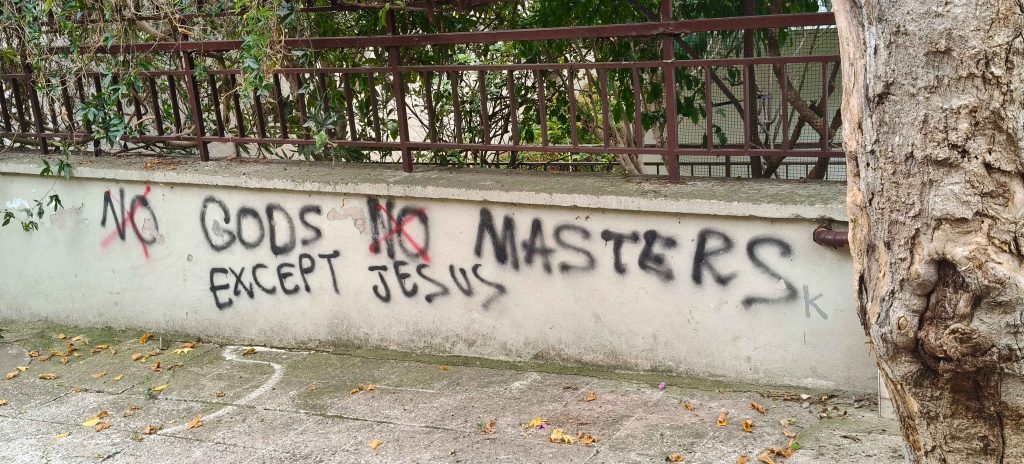
Graffiti at a wall in Heybeliada at the Princes’ Islands (Adalar) where the Hagia Triada Monastery and Seminar school is located. Picture by Mezmur Holmström.
In summary, multiple noteworthy events occurred during the three Abrahamic visits.
For Judaism, it was the first time a pope met with the chief rabbi of Istanbul.
Regarding Islam, the Pope was explicitly invited to participate in the mosque prayer. This meant that he was offered the opportunity to recite parts of the Islamic prayers with the other Islamic leaders who were present.
Together with the Ecumenical Patriarch, the Pope recited the Nicene Creed without the papal addition of the filioque.
Upon observing the Orthodox worship and teachings within each Abrahamic religion, one can find many common patterns, both visual and scriptural. Examples include praying under domes, on carpeted floors, and facing what is considered holy (Mecca, Jerusalem, or the east); vocal worship and recitation without musical instruments; and similar practices. Of course, there is also the history and high regard of Abraham.
My main question is: How far can interreligious cooperation go? These steps toward interfaith peace seem successful, but have we reached the goal? Is there more to be done? Where is the limit, if there is one?
1 The term orthodoxy is common within Judaism and Christianity. It I is appliable for Islamic faith but it is not commonly used. A more common term would be, ahl al-sunna wa-l-jamaʿa.
Mezmur Holmström
The theological course ”Interreligious Relations in Istanbul and Beyond: The role of Religion in Society, State and Secularism” is a thematic course organized by the theological subjects at Åbo Akademi University during the fall semester 2025 and culminated in a study trip to Istanbul from 6–16 November. The course is conducted in close collaboration with the Swedish Research Institute in Istanbul (SRII) and with the Finnish Institute in the Middle East (FIME). This blog text is the third of eight blog texts to present reflections of the study trip.
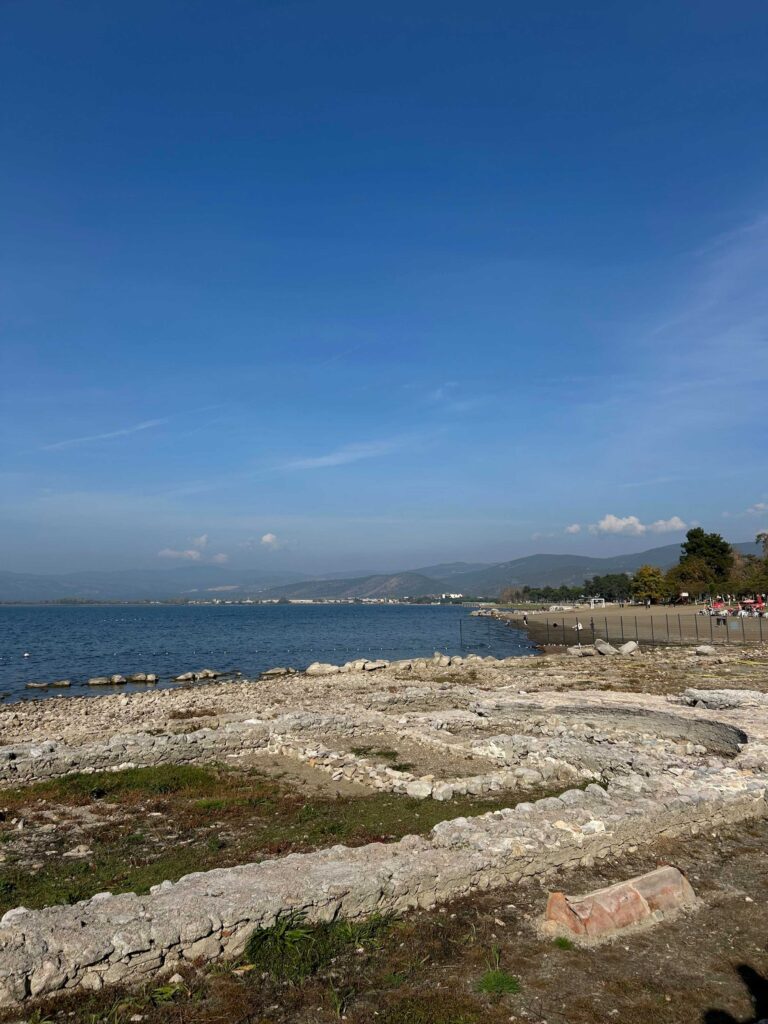
After an eventful day in Iznik, one of our last visits was to the Basilica of Saint Neophytos. In 2014, the Bursa Metropolitan Municipality took pictures of the Iznik River, where archaeologist Mustafa Sahin discovered an underwater basilica. The Basilica is believed to have been built in the 4th century AD. When the archaeologist discovered the basilica, it was about two meters underwater and 50 meters from the shore. The Archaeological Institute of America selected the basilica as one of the world’s top 10 archaeological discoveries in 2014. In 2015, Turkish archaeologists began underwater excavations, during which they found damaged tombs and skeletons. The archaeologists restored the tombs and skeletons to their original condition with tiles after documenting and photographing them. Several archaeologists consider the basilica to be a prime example of early Christian architecture.
Upon discovering the basilica, archaeologists began to ponder three matters regarding its history: First, is this the lost Temple of Apollo of Roman Emperor Commodus? Was this the lost Church of Saint Neophtyos? And was the First Council of Nicaea held in this building? However, the church ruins date from the late fourth century, indicating that the council could not have been held at this basilica. Some speculate that another structure stood at this location before the basilica was built, but there is no explicit evidence to support this theory. No one can say for certain where the First Council of Nicaea was held.
Picture by Siri Mathisen.
When we visited the Basilica of Iznik, a new ramp had just opened, leading straight to the front of the building. The intention was to open the cultural landscape of Iznik and create an important attraction for tourists and other visitors. Perhaps the intention was also to incorporate Iznik and the basilica into Christian pilgrimage and religious tourism. For the most part, one could only see the outlines and stones remaining from the basilica, as well as several tombs. From these outlines, one could easily envision the original structure.
Not long after our field research, Pope Leo XIV visited the basilica on November 28th to celebrate the 1700th anniversary of the First Council. At the basilica, Pope Leo XVI took part in an ecumenical prayer meeting, where he spoke extensively about the Nicene Creed of Christ’s divinity unites all Christians into a deep bond, unity and universal brotherhood.
Just a few years ago, the basilica was underwater, but today, the water level has receded. Many archaeologists question how the water level could have receded. Did it happen naturally, or was it done to cleanse up the basilica in preparation for Pope Leo XIV visit to Iznik? Before visiting the basilica, I thought I would see an underwater basilica. However, it was more exciting to admire the details and view up close.
Visiting the Basilica of Saint Neophytos gave me insight into early Christian history and sparked my interest in reading more about the basilica and Iznik. Hopefully, Pope Leo XIV’s visit to Iznik will bring more attention to the basilica and its history and significance.
Siri Mathisen
The theological course ”Interreligious Relations in Istanbul and Beyond: The role of Religion in Society, State and Secularism” is a thematic course organized by the theological subjects at Åbo Akademi University during the fall semester 2025 and culminated in a study trip to Istanbul from 6–16 November. The course is conducted in close collaboration with the Swedish Research Institute in Istanbul (SRII) and with the Finnish Institute in the Middle East (FIME). This blog text is the second of eight blog texts to present reflections of the study trip.
This blog text is a result of the thematic course “Interreligious Relations in Istanbul and Beyond: The role of Religion in Society, State and Secularism” at Åbo Akademi University through the Polin Institute because of the jubilee of the council in Nicaea that took place in the year of our Lord 325.
It has been an incredibly enriching course. Not only were we able to experience history first-hand, but we also had the opportunity to meet amazing people and gain insights into subjects that are rarely covered in books. Special thanks must also go to Olof Heilo and the Swedish Research Institute Istanbul (SRII), who hosted us, showed us around and introduced us to an Istanbul that is only accessible through someone with in-depth academic knowledge of the area.

Mustafa Kemal Atatürk greeted us as we arrived by bus to İznik, former Nicaea. Picture by Laura Wickström.
There will be seven additional blog posts, which I expect will go into more detail about what we learnt and saw during our ten-day stay in the historic city. However, I want to talk about how some of us in the group (especially me) coped with long, information-heavy days. This blog post is intended as a humorous reflection on the time spent in Istanbul. I enjoyed every minute of the course, and I would like to express my gratitude to Laura Wickström for her monumental efforts in creating this experience and providing us with the opportunity to learn on site.
Those with a keen eye may have noticed that the title “Opium Des Istanbul” is a play on Karl Marx’s famous phrase “Opium des Volkes”, meaning “the opium of the people”. The context of this statement is the idea that opium dulls a person’s pain, and religion can dull the pain of a society. In other words, it is a metaphysical ibuprofen against the sufferings of the world.
“What does any of this have to do with a thematic course in Istanbul?” you might ask. Let me paint you a picture.
Imagine you are in Istanbul. You have a schedule, but it is prone to change due to the different approach to time in Turkey, so even if you think you know what the day will look like, you never really do. There is a lot of uncertainty, but you know that whatever happens, you will be walking, standing, listening and learning a lot. Now add to the mix a leader and teacher from whom we seek guidance in these circumstances — for the record, I’m talking about Laura — who mentions a free afternoon at some point. A time of rest, relaxation and freedom; an oasis where weary legs can be rejuvenated. However, like the Second Coming for the Millerite movement (and countless others), the prophecy of this promised time is postponed when it does not occur as foretold.

2nd century depiction of Cybele from Iznik also known by the Romans as Magna Mater, the great mother, she is an Anatolian mother goddess. The picture is unrelated, but I can imagine as the great mother she would also enjoy the prospect of a free afternoon. Picture by Anni Maria Laato.
It is in these circumstances that the cult of the free afternoon is established; it is the remedy that alleviates the burning sensation in the legs caused by hours of walking. It offers hope of a time when the mind can reflect on and process what has been seen and heard. It is the “Opium des Istanbul”, a refuge to which we can retreat regardless of schedule changes, early mornings, late evenings, or getting lost in the bustling streets of Istanbul.
As I said earlier, this is a humorous approach, but it was also a joke that kept our spirits up when we were tired, hungry, and in pain from our legs. So, it worked very much like a metaphysical ibuprofen. It’s also important to mention that the prophecy was fulfilled: we had free afternoons on several occasions. However, at some of these, we were “strongly encouraged” to take part in certain activities, and instead, we had the option to discuss the illusion of free will.

Visit to the School of Education, Atatürk Eğitim Fakültesi at Aydınevler, Marmara University. From the left: Jonathan Stipesevic, Prof. Seyfi Kenan, Laura Wickström and Anni Maria Laato.
All jokes aside, I learned a lot of things that I will carry with me for the rest of my life. The course title, ”The Role of Religion in Society, State, and Secularism,” was fitting because we delved deeply into these subjects. Examining them in a culture different from my own has helped me see our own culture in a new light. One topic that I found very interesting was the discussion of secularism. A professor we met mentioned the ezan (call to prayer) as secular. When I pressed on the subject, we exchanged comments but never reached a conclusion. Then, when I heard church bells back in Finland, I thought about the ezan in Istanbul. I started to see the professor’s point. The call is still rooted in religious tradition, but in a secular town, it’s just noise. When I hear church bells, I don’t immediately associate them with religion. I might enjoy the sound, check the time, or simply ignore them. Perhaps the ezan is that for the people of Istanbul: a religious whisper in a secular arena. Those who are religious hear the call; the others might listen for a while or look at the time. For them, it might just be the sound of a secular town. This has changed my understanding of the distinction between the ”holy” and the ”profane” as being more subjective and culture-bound. What I might perceive as obviously religious might be so integrated into someone else’s culture that they don’t even notice it.
Beyond academia, this course has given me a new perspective on my own life and prompted reflection. Visiting the 23.5 Hrant Dink Site of Memory was especially moving, as was witnessing the fight to preserve one’s heritage and background.
This course has been a memorable chapter in my life, and I am grateful to everyone involved.
Jonathan Stipesevic
The theological course ”Interreligious Relations in Istanbul and Beyond: The role of Religion in Society, State and Secularism” is a thematic course organized by the theological subjects at Åbo Akademi University during the fall semester 2025 and culminated in a study trip to Istanbul from 6–16 November. The course is conducted in close collaboration with the Swedish Research Institute in Istanbul (SRII) and with the Finnish Institute in the Middle East (FIME). This blog text is the first of eight blog texts to present reflections of the study trip.

19.12.2025 | Temakurs
The importance of a common language and understanding in interreligious dialogue
Throughout the course, the focus has been on interreligious interactions and dialogue. We discussed how history has affected us, how doctrine written in a different society affects us in a more secular and postmodern society, and how this understanding impacts interreligious dialogue. Languages play a significant role in our surroundings, culture, and life. They take […]

17.12.2025 | Temakurs
Searching for the lost Chalcedon
When visiting the modern and bustling district of Kadiköy, it is difficult to imagine it having any connection to the ancient city of Chalcedon. One of the first sights we saw when we visited on 10 November was a Starbucks, quickly followed by streets where anyone looking for anime and band merchandise, alternative clothing or […]

15.12.2025 | Temakurs
Medieval Spanish in Istanbul?
What comes to mind when you think of a liturgical language? Latin? Sanskrit? Perhaps classical Arabic? The following blog post is dedicated to the intriguing and mystical language of Ladino. Ladino is a spoken language within the global Sephardic community. The Sephardic community consists of Jews who lived in the Iberian Peninsula during the Middle […]

10.12.2025 | Temakurs
In awe of Hagia Sophia?
What is the place of religion in a secular society? How should we understand secularism? Can there be peace among people with different beliefs? Do we need to establish common ground before we can discuss anything? Is it necessary to agree in order to have a fruitful dialogue? Who dictates the course of the state? […]

08.12.2025 | Temakurs
Our journey to Iznik
Our journey to Iznik began in Istanbul on November 8, 2025. We boarded a ferry and then a bus for a two-hour ride to our destination. The scent of morning coffee and the beautiful sunrise fueled our excitement as we awaited what was to come. Our first stop was the ”Hagia Sophia Iznik” mosque (picture […]

05.12.2025 | Temakurs
The God Under the Dome. Dancing with the devil or obeying the one God
While visiting Turkey and some of its most important historical sites from a religious perspective, we stood with many different people who were all pursuing the one God under their own dome. We discussed and learned about the pursuit of God in Islam, Judaism, and Christianity. The question slowly arose: All three religions proclaim the […]

03.12.2025 | Temakurs
The Sunken Basilica of Saint Neophytos
After an eventful day in Iznik, one of our last visits was to the Basilica of Saint Neophytos. In 2014, the Bursa Metropolitan Municipality took pictures of the Iznik River, where archaeologist Mustafa Sahin discovered an underwater basilica. The Basilica is believed to have been built in the 4th century AD. When the archaeologist discovered […]

01.12.2025 | Temakurs
Opium Des Istanbul
This blog text is a result of the thematic course “Interreligious Relations in Istanbul and Beyond: The role of Religion in Society, State and Secularism” at Åbo Akademi University through the Polin Institute because of the jubilee of the council in Nicaea that took place in the year of our Lord 325. It has been […]