
The importance of a common language and understanding in interreligious dialogue
19 december, 2025
Throughout the course, the focus has been on interreligious interactions and dialogue. We discussed how history has affected us, how doctrine written in a different society affects us in a more secular and postmodern society, and how this understanding impacts interreligious dialogue.
Languages play a significant role in our surroundings, culture, and life. They take many forms, such as art, symbols, body language, and spoken or written words. By studying language, one can learn a great deal about cultural trends, political beliefs, values, and society. Understanding language allows us to experience our surroundings and the world and make sense of it all. Therefore, understanding the language is of the utmost importance.
This is something we do in any research or thesis: we define the words we use and explain how they should be understood.
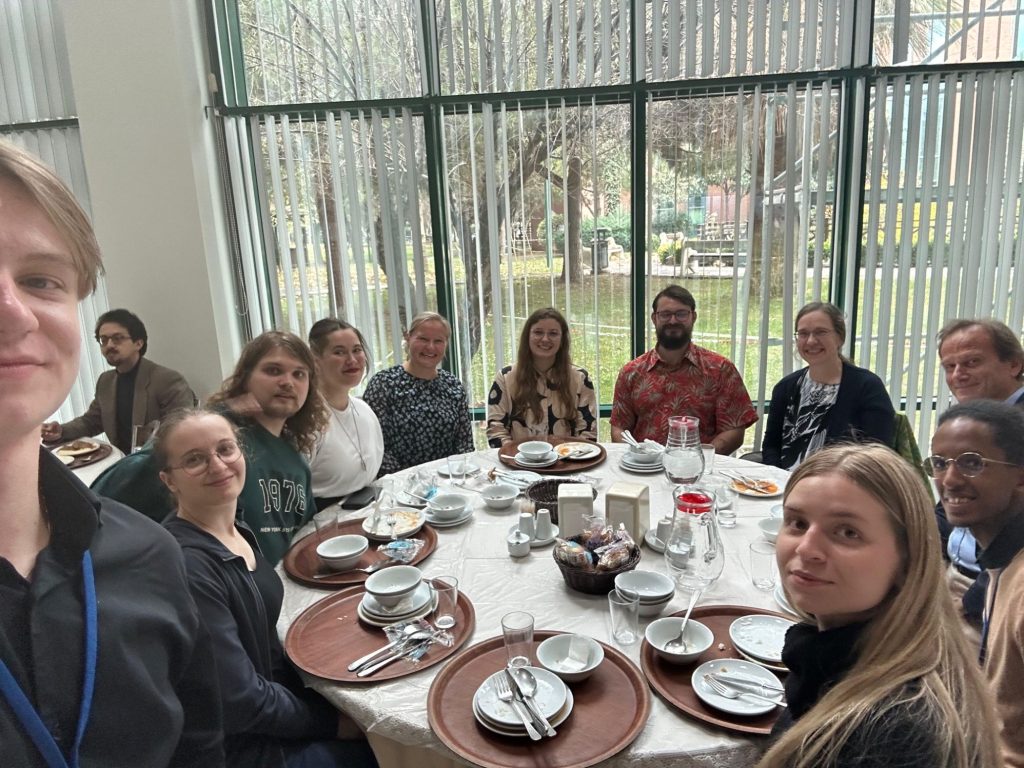
Visit at the İSAM (Centre for Islamic Studies), where we discussed secularism. The meal symbolized interreligious dialogue, showing that despite our different views, we can still sit down at the same table. Photo by Salomon Backlund.
During our visit to İSAM (Centre for Islamic Studies), we realized that our understanding of the meaning of words differs from one another. During a conversation with representatives, we discussed secularism and how we understand the term ”secular.”
Since the time of Kemal Atatürk, the Turkish constitution has defined Turkey as a secular state. However, the definition of secularism seems to have changed over time. During Atatürk’s regime, politics were strictly separated from religion, even resulting in the closure of religious schools. Nowadays, the constitution defines Turkey as a secular state that includes protections for religious freedom. However, the modern Turkish state also enforces laws that restrict religious freedom and control religious activities, e.g., the ban on religious activities outside dedicated buildings and the state’s control over permits for such buildings.
The main question discussed was how a secular state can have such a prominent influence from one specific religion. Calls to prayer are a prime example, as is the number of schools dedicated to Islamic studies.
According to the professor we met, the word ”secular” could be defined as a religion so deeply rooted in the state that it is evident throughout society.
Turkey has become so intertwined with the Islamic faith that it has become increasingly difficult to distinguish where one ends and the other begins. In a sense, it could be said that to be Turkish is to be Muslim. However, not everyone shares this view.
From a Western understanding of secularism, this can be difficult to grasp. Western secularism has often positioned itself as the opposite of religious belief. It has relied on philosophy and science, working to dissociate itself from religion.
The professor described Islam as a worldly and secular religion. He explained how Islam impacts every aspect of society—morally, politically, and spiritually—and concluded that it is a secular faith in a secular state.
He continued to explain how Christianity was considered the opposite of a secular faith, thus making it non-secular. According to him, the reason Christianity was not considered secular was its focus on spirituality. One justification for this would be the Kingdom of God, which is not situated in this world.
This view of secularism also impacts how religious freedom is understood. In Finland, we do not have a state religion, even though Christianity is the predominant faith. We value religious freedom highly. To us, religious freedom means the freedom to choose which, if any, faith one wants to belong to, and the state will not interfere with that freedom. Turkey, on the other hand, also professes religious freedom but holds a completely different view of its contents. The fusion of state and religion creates an interesting context for religious freedom.
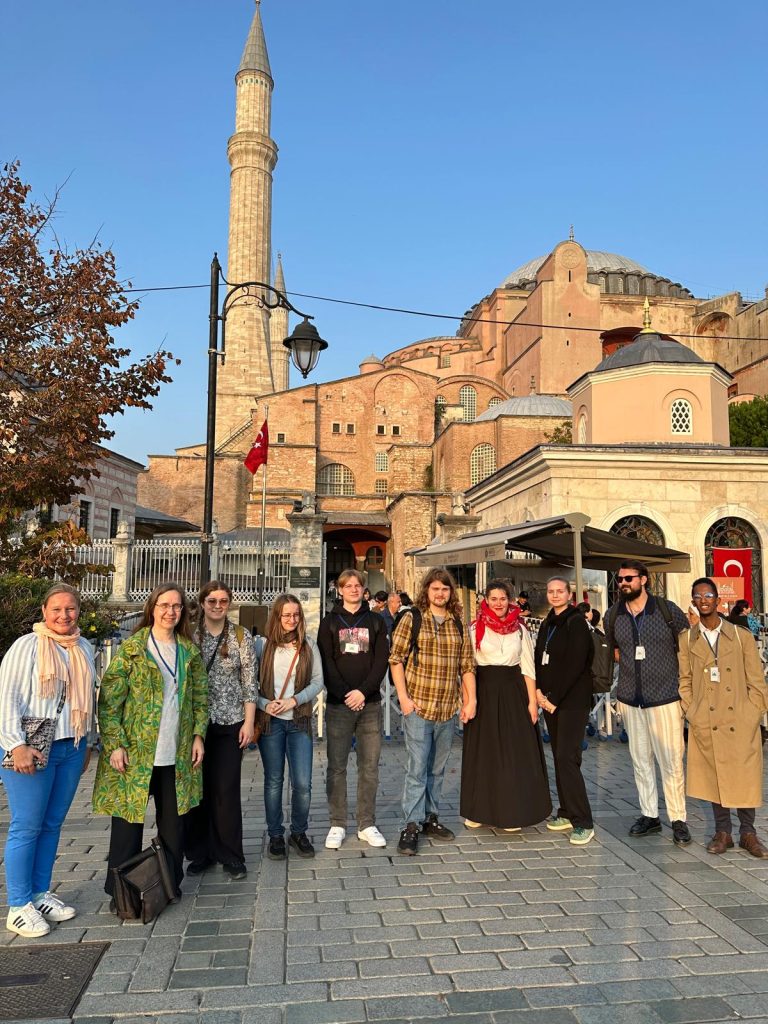
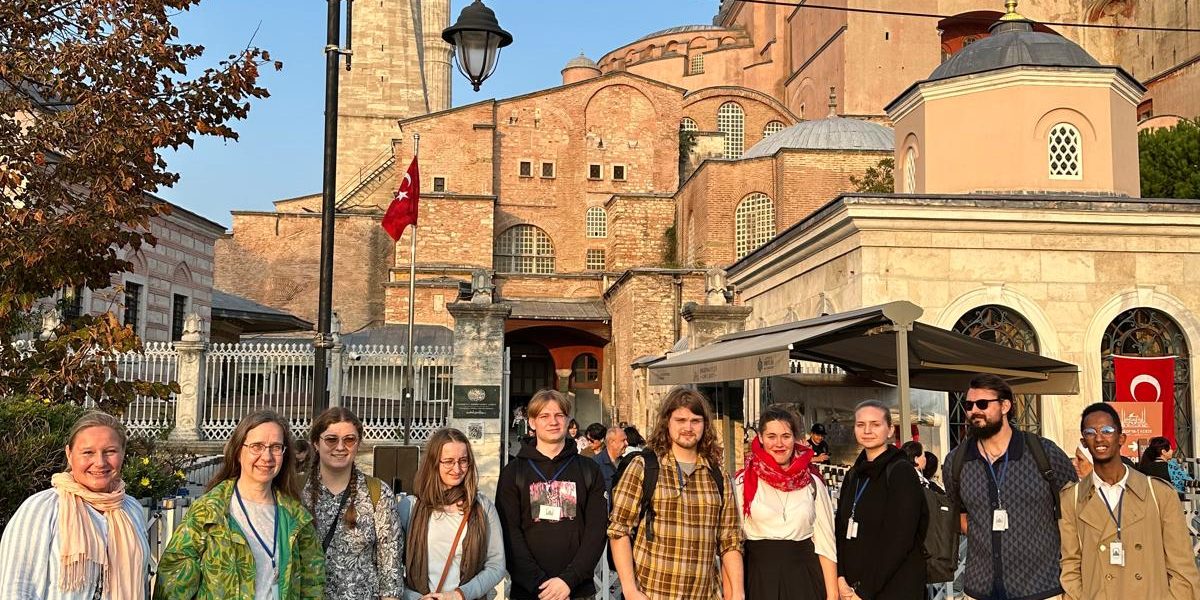
The group is outside of Hagia Sophia, where Christianity and Islam meet. Today, Hagia Sophia is a mosque, but traces of Christianity remain inside.
In conclusion, we must define the words we use and express our understanding of them to convey meaning that can be understood by someone from a different context. Language defines us as humans, and it is through language that we can express our thoughts. However, language cannot be understood unless we first understand the words we use.
Mona Nurmi
The theological course ”Interreligious Relations in Istanbul and Beyond: The role of Religion in Society, State and Secularism” is a thematic course organized by the theological subjects at Åbo Akademi University during the fall semester 2025 and culminated in a study trip to Istanbul from 6–16 November. The course is conducted in close collaboration with the Swedish Research Institute in Istanbul (SRII) and with the Finnish Institute in the Middle East (FIME). This blog text is the last of eight blog texts to present reflections of the study trip.