
Opium Des Istanbul
December 1, 2025
This blog text is a result of the thematic course “Interreligious Relations in Istanbul and Beyond: The role of Religion in Society, State and Secularism” at Åbo Akademi University through the Polin Institute because of the jubilee of the council in Nicaea that took place in the year of our Lord 325.
It has been an incredibly enriching course. Not only were we able to experience history first-hand, but we also had the opportunity to meet amazing people and gain insights into subjects that are rarely covered in books. Special thanks must also go to Olof Heilo and the Swedish Research Institute Istanbul (SRII), who hosted us, showed us around and introduced us to an Istanbul that is only accessible through someone with in-depth academic knowledge of the area.

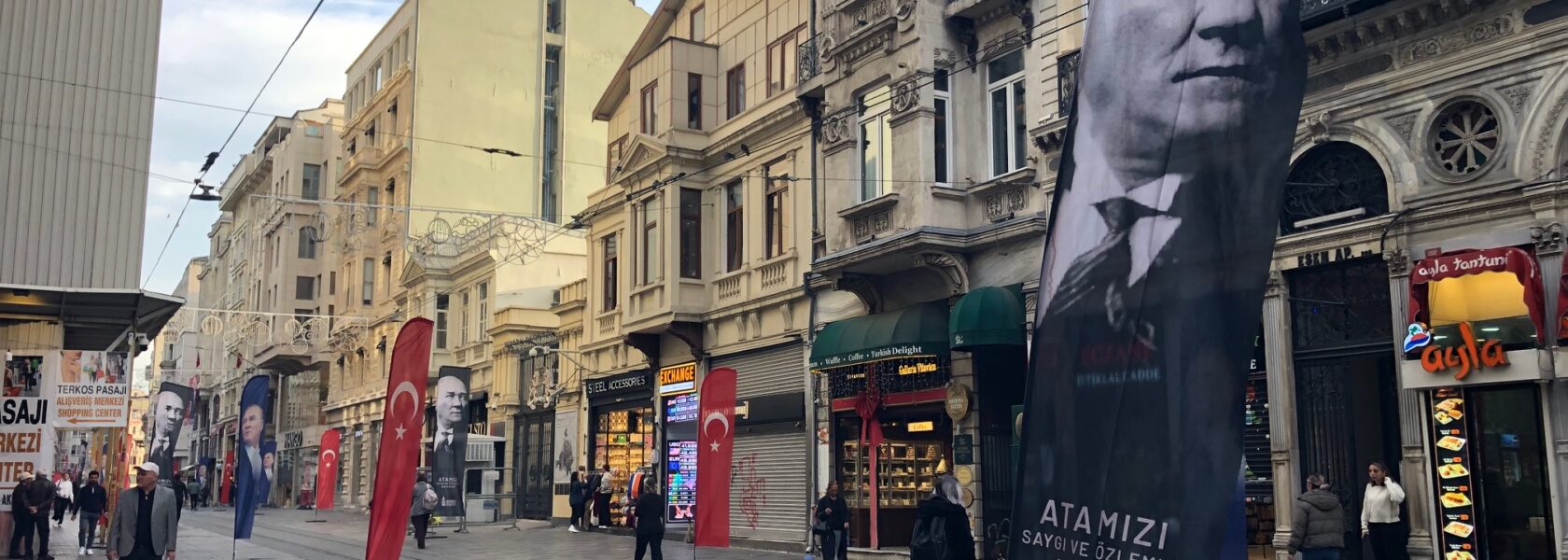
Mustafa Kemal Atatürk greeted us as we arrived by bus to İznik, former Nicaea. Picture by Laura Wickström.
There will be seven additional blog posts, which I expect will go into more detail about what we learnt and saw during our ten-day stay in the historic city. However, I want to talk about how some of us in the group (especially me) coped with long, information-heavy days. This blog post is intended as a humorous reflection on the time spent in Istanbul. I enjoyed every minute of the course, and I would like to express my gratitude to Laura Wickström for her monumental efforts in creating this experience and providing us with the opportunity to learn on site.
Those with a keen eye may have noticed that the title “Opium Des Istanbul” is a play on Karl Marx’s famous phrase “Opium des Volkes”, meaning “the opium of the people”. The context of this statement is the idea that opium dulls a person’s pain, and religion can dull the pain of a society. In other words, it is a metaphysical ibuprofen against the sufferings of the world.
“What does any of this have to do with a thematic course in Istanbul?” you might ask. Let me paint you a picture.
Imagine you are in Istanbul. You have a schedule, but it is prone to change due to the different approach to time in Turkey, so even if you think you know what the day will look like, you never really do. There is a lot of uncertainty, but you know that whatever happens, you will be walking, standing, listening and learning a lot. Now add to the mix a leader and teacher from whom we seek guidance in these circumstances — for the record, I’m talking about Laura — who mentions a free afternoon at some point. A time of rest, relaxation and freedom; an oasis where weary legs can be rejuvenated. However, like the Second Coming for the Millerite movement (and countless others), the prophecy of this promised time is postponed when it does not occur as foretold.
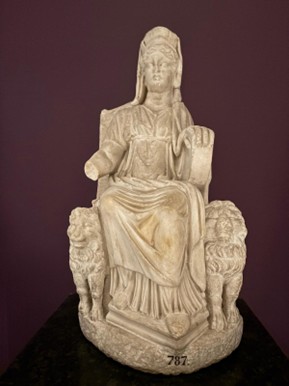
2nd century depiction of Cybele from Iznik also known by the Romans as Magna Mater, the great mother, she is an Anatolian mother goddess. The picture is unrelated, but I can imagine as the great mother she would also enjoy the prospect of a free afternoon. Picture by Anni Maria Laato.
It is in these circumstances that the cult of the free afternoon is established; it is the remedy that alleviates the burning sensation in the legs caused by hours of walking. It offers hope of a time when the mind can reflect on and process what has been seen and heard. It is the “Opium des Istanbul”, a refuge to which we can retreat regardless of schedule changes, early mornings, late evenings, or getting lost in the bustling streets of Istanbul.
As I said earlier, this is a humorous approach, but it was also a joke that kept our spirits up when we were tired, hungry, and in pain from our legs. So, it worked very much like a metaphysical ibuprofen. It’s also important to mention that the prophecy was fulfilled: we had free afternoons on several occasions. However, at some of these, we were “strongly encouraged” to take part in certain activities, and instead, we had the option to discuss the illusion of free will.
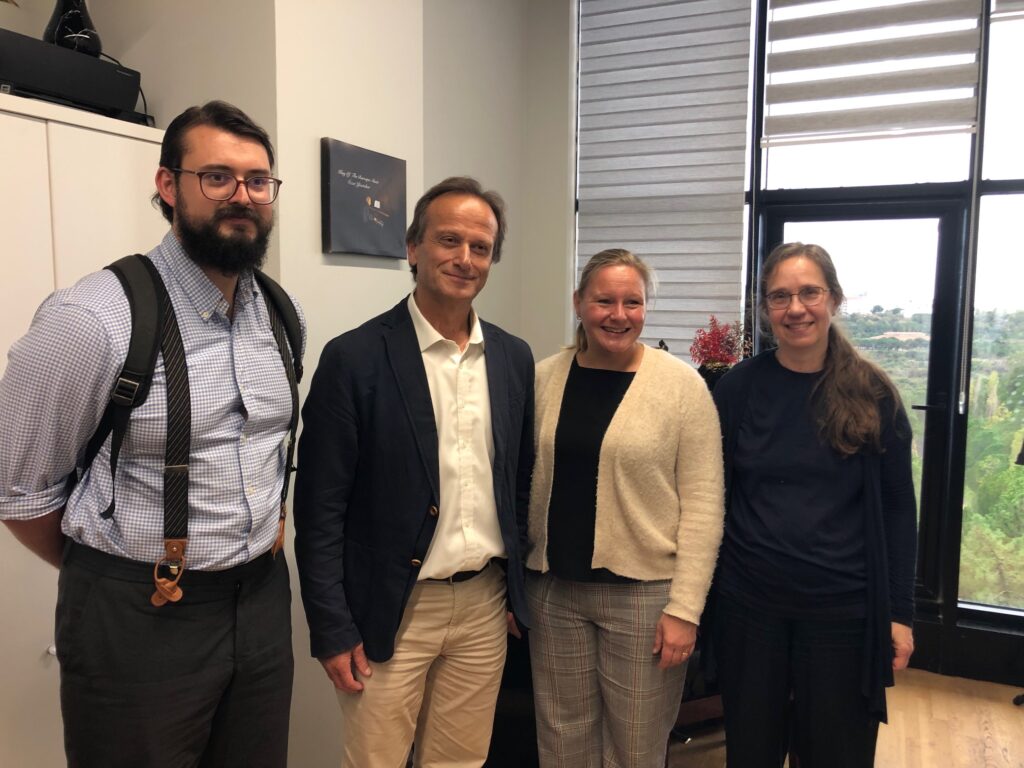
Visit to the School of Education, Atatürk Eğitim Fakültesi at Aydınevler, Marmara University. From the left: Jonathan Stipesevic, Prof. Seyfi Kenan, Laura Wickström and Anni Maria Laato.
All jokes aside, I learned a lot of things that I will carry with me for the rest of my life. The course title, ”The Role of Religion in Society, State, and Secularism,” was fitting because we delved deeply into these subjects. Examining them in a culture different from my own has helped me see our own culture in a new light. One topic that I found very interesting was the discussion of secularism. A professor we met mentioned the ezan (call to prayer) as secular. When I pressed on the subject, we exchanged comments but never reached a conclusion. Then, when I heard church bells back in Finland, I thought about the ezan in Istanbul. I started to see the professor’s point. The call is still rooted in religious tradition, but in a secular town, it’s just noise. When I hear church bells, I don’t immediately associate them with religion. I might enjoy the sound, check the time, or simply ignore them. Perhaps the ezan is that for the people of Istanbul: a religious whisper in a secular arena. Those who are religious hear the call; the others might listen for a while or look at the time. For them, it might just be the sound of a secular town. This has changed my understanding of the distinction between the ”holy” and the ”profane” as being more subjective and culture-bound. What I might perceive as obviously religious might be so integrated into someone else’s culture that they don’t even notice it.
Beyond academia, this course has given me a new perspective on my own life and prompted reflection. Visiting the 23.5 Hrant Dink Site of Memory was especially moving, as was witnessing the fight to preserve one’s heritage and background.
This course has been a memorable chapter in my life, and I am grateful to everyone involved.
Jonathan Stipesevic
The theological course ”Interreligious Relations in Istanbul and Beyond: The role of Religion in Society, State and Secularism” is a thematic course organized by the theological subjects at Åbo Akademi University during the fall semester 2025 and culminated in a study trip to Istanbul from 6–16 November. The course is conducted in close collaboration with the Swedish Research Institute in Istanbul (SRII) and with the Finnish Institute in the Middle East (FIME). This blog text is the first of eight blog texts to present reflections of the study trip.