
Our journey to Iznik
December 8, 2025
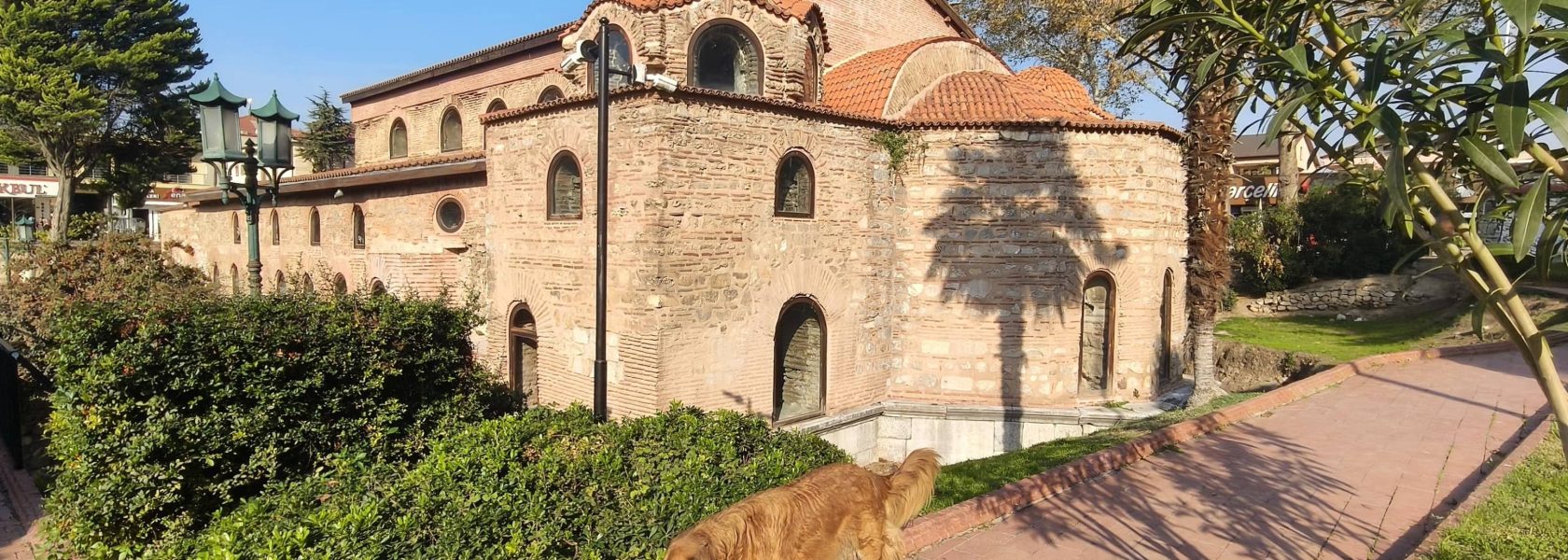
Our journey to Iznik began in Istanbul on November 8, 2025. We boarded a ferry and then a bus for a two-hour ride to our destination. The scent of morning coffee and the beautiful sunrise fueled our excitement as we awaited what was to come. Our first stop was the “Hagia Sophia Iznik” mosque (picture above). This structure was likely rebuilt around the 600s, so the original church was probably built around the 4th century. After the Ottoman conquest, the church was converted into a mosque in 1331. Upon entering the mosque and walking to the far wall, one could see the icon paintings from the church era. The images were somewhat unclear since the paint had faded over time.
It was interesting to see the Hagia Sophia Iznik. One can see the division of the building: the old part was a church, and the new part is a mosque. The old part was a church, and the new part is a mosque. By this, I mean that the building still bears traces of its past. The “tracks” I refer to are the icon paintings and the apse, as mentioned before. In traditional churches, the apse is usually the innermost section where the altar is located, and this section remained intact.
The city of İznik has deep roots in the pottery industry. It is well known worldwide for its famous “Iznik tiles.” These tiles are best known for their use in mosques, such as the Blue Mosque. Iznik pottery is unique because of its fine quality. Iznik pottery contains around 80-90% quartz, and its most recognizable colors are: Cobalt blue, emerald green, turquoise, and a distinctive red.

Roman theater in Iznik. Picture by Salomon Backlund.
Later in the day, we left to visit a Roman theater. Gladiators once battled in this very location. Constructed around the 2nd century, the theater is estimated to have held 10,000 people. Upon entering this historical site, it’s clear that the structure has many stories to tell. During the fifth century, the theater was used for religious purposes, which is believed to have lasted until the sixth century.
Our journey to Iznik was coming to an end, so we boarded the bus and ferry back to Istanbul once more. I believe it’s safe to say that, as a group, we all enjoyed our day in Iznik and are happy to have made memories there.
Also, we must mention the significant event that occurred in Iznik 1,700 years ago: the Council of Nicaea in 325. It is uncertain where the Council of Nicaea took place in 325; thus, it is known only that it was held. At the council, matters of faith were discussed, and the Nicaean
creed was formulated. The main topic of discussion was the teachings of Arianism, which were later declared heretical.
Iznik is a city rich in culture and history that welcomes visitors and those who seek knowledge of its past.
Salomon Backlund
The theological course ”Interreligious Relations in Istanbul and Beyond: The role of Religion in Society, State and Secularism” is a thematic course organized by the theological subjects at Åbo Akademi University during the fall semester 2025 and culminated in a study trip to Istanbul from 6–16 November. The course is conducted in close collaboration with the Swedish Research Institute in Istanbul (SRII) and with the Finnish Institute in the Middle East (FIME). This blog text is the fourth of eight blog texts to present reflections of the study trip.