
Medieval Spanish in Istanbul?
December 15, 2025
What comes to mind when you think of a liturgical language? Latin? Sanskrit? Perhaps classical Arabic? The following blog post is dedicated to the intriguing and mystical language of Ladino.
Ladino is a spoken language within the global Sephardic community. The Sephardic community consists of Jews who lived in the Iberian Peninsula during the Middle Ages. In 1492, Spain expelled its Jews, and Portugal followed suit in 1497. These expulsions shattered the Iberian Jewish communities, forcing them to resettle around the Mediterranean. One surprising destination was the Ottoman Empire. To the modern European, the concept of Sharia law evokes images of tyranny against non-Muslims. However, this was preferable for 16th-century Jews living in a continent ravaged by religious wars and inquisitions. The Balkans and Asia Minor became central hubs for the Sephardic community until the early 20th century.

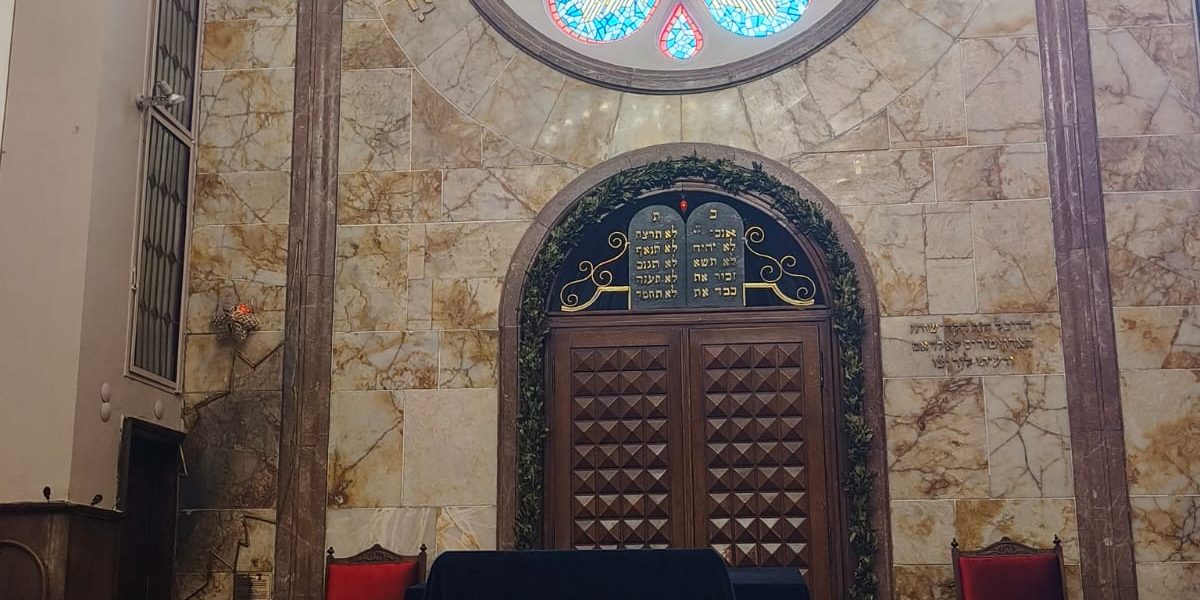
Visit to the Sephardic synagogue. Photo by Alexander Renqvist.
The language of the Sephardic community has many names. Some of these names include Judeo-Spanish, Sephardic, Judesmo, and Ladino. Ladino is unique as a language. It is a Romance language, like its much larger siblings Spanish, French, and Italian. Many of the words in Ladino are archaic. The expulsion caused Ladino speakers to become isolated from the rest of the Spanish-speaking world. This is why linguists point out that Ladino is more closely related to medieval Castilian than to contemporary Spanish. An example of this is the word for “son.” The Latin word for son is filius. In modern Spanish, it is “hijo.” In Ladino, the word for “son” is fijo, which has undergone fewer phonological changes than its Spanish counterpart. Of course, Ladino does not consist only of archaic Spanish; it has also been influenced by neighboring languages with which it interacted in the Balkans, such as Greek, Turkish, and Bulgarian.
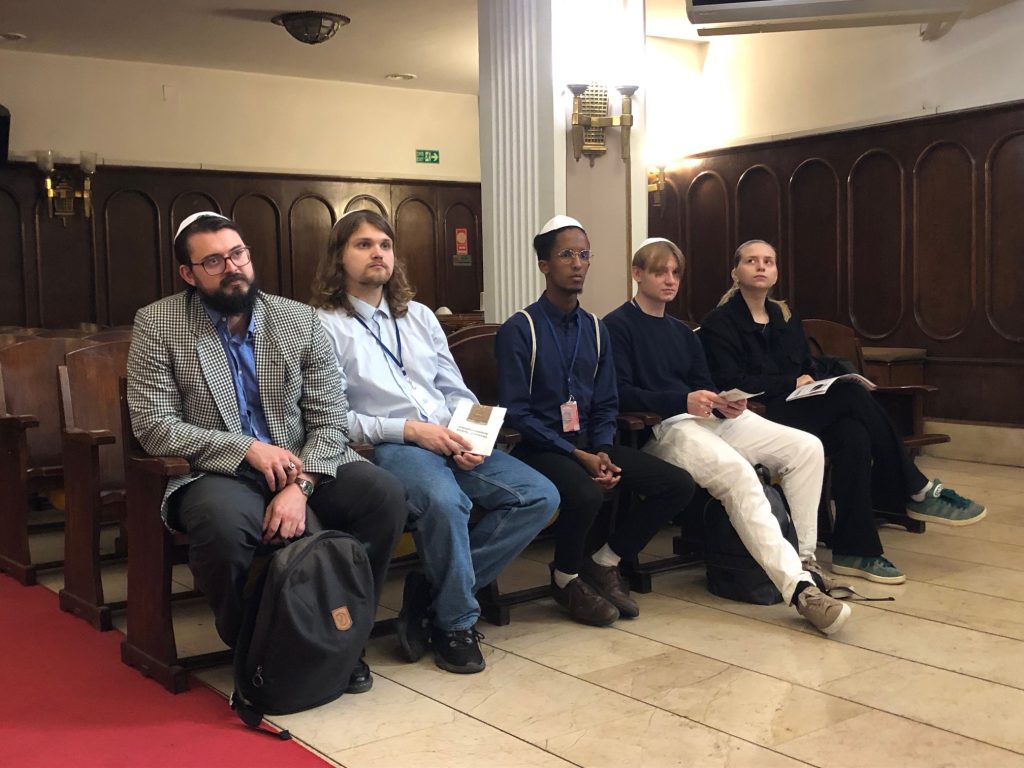
The students are listening attentively to the presentation on the synagogue given by the director and curator of the Jewish Museum, Mrs. Nisya Allovi. From left to right in the picture are Jonathan Stipesevic, Alexander Renqvist, Mezmur Holmström, Salomon Backlund, and Siri Mathisen. Photo by Laura Wickström.
The creation of the State of Israel forever changed the demographics of the global Jewish diaspora. The emigration of Jews from the Balkans severely decreased the number of Ladino speakers. The revival of Modern Hebrew posed a challenge to spoken Jewish languages, such as Ladino and Ashkenazi.
To this day, Ladino is rarely spoken as a first language by its speakers. It is more frequently used by older generations. Nevertheless, it continues to have an influence in Sephardic synagogues across the Mediterranean.
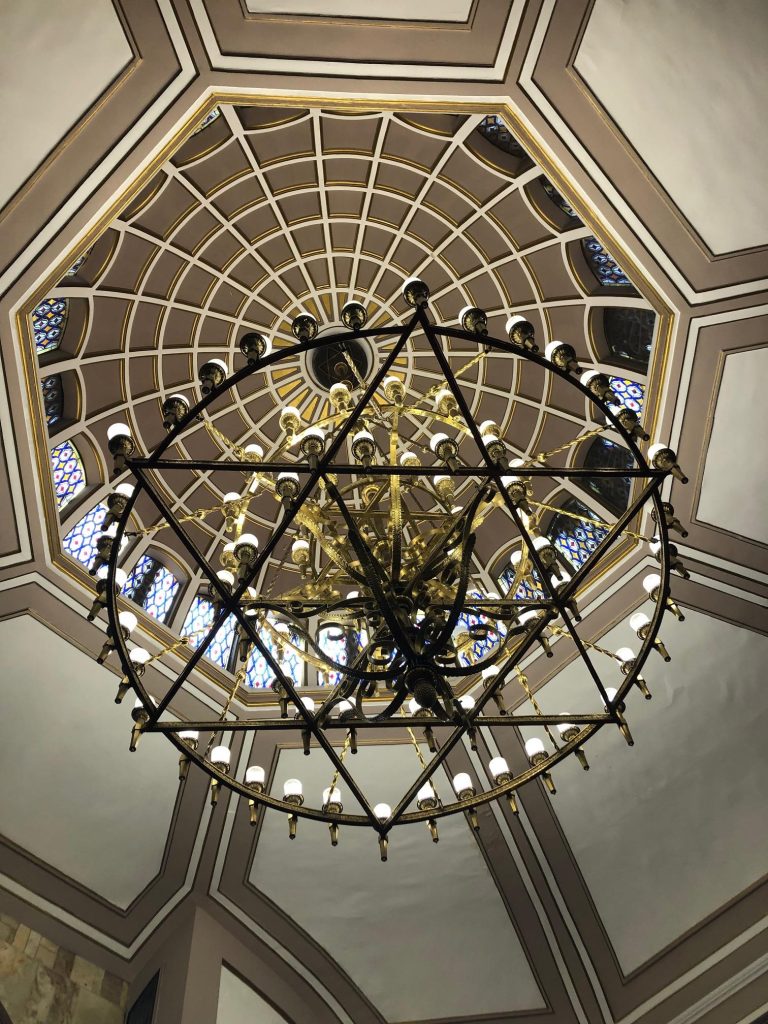
The beautiful chandelier in the Sephardic synagogue.
The Sephardic community preserves Ladino as a liturgical language. It is used in hymns, prayers, family stories, lullabies, and Torah translations. One famous use of Ladino among the Sephardic community is its proverbs. Below, I have written down my favorite Ladino proverbs with English translations.
He who sells the sun must buy candles. Quien vende el sol, merca la candela.
If you love a rose, you must ignore the thorns. Quien quere á la rosa, non mire al espino
Better a donkey that carries me than a horse that throws me. Mas vale un asno que me lleva, que un caballo que me echa.
A sweet mouth opens iron doors. Boca dulce abre puertas de hiero.
The camel can see others’ humped backs, and not his own. El gamello vee solo la corcova de otros, y no la suya propia.
Seeing me is a pleasure; having me is a tragedy. Quien mi vee mi goza, quien mi tiene mi llora.
Proverbs offer a glimpse into the culture, humor, and common wisdom of an endangered language. If you enjoy these proverbs and would like to read more, click on this link.
Alexander Renqvist
The theological course ”Interreligious Relations in Istanbul and Beyond: The role of Religion in Society, State and Secularism” is a thematic course organized by the theological subjects at Åbo Akademi University during the fall semester 2025 and culminated in a study trip to Istanbul from 6–16 November. The course is conducted in close collaboration with the Swedish Research Institute in Istanbul (SRII) and with the Finnish Institute in the Middle East (FIME). This blog text is the sixth of eight blog texts to present reflections of the study trip.