

Jewish Studies in the Nordic Countries
Junior Researcher Conference
Turku, Finland 9-10 November, 2026
This is a conference for scholars in all disciplines whose research can be classified as “Jewish Studies”. It is especially geared towards junior researchers (PhD students and recent PhD graduates). Senior scholars are also very welcome, but we reserve the option of presenting for junior scholars. Senior scholars participating will be asked to give response to a presentation. At the conference you can present your research:
work-in-progress, recently finished projects or planned future projects, and receive feedback from colleagues from all the Nordic countries. Presentations should be no longer than 20 minutes.
Time will also be allotted for small group discussions when all who so wish will receive career advice and feedback on your CV from a senior scholar.
The conference is co-organised by:
Institutum Iudaicum, Åbo Akademi University
The Donner Institute for Research into Religion and Culture
The Inez and Julius Polin Institute for Theological Research
Södertörn University
Deadline for abstract submission: August 15
Deadline for registration: September 30
The link for submitting your abstract is found here. The link for the conference registration is found here.
Keynote lecture: Professor Lena Roos, Södertörn University: Diaspora and Zionism, Longing and Belonging. 20th Century Rabbinic Reflection on Homelands and Nationalism
There will be no conference fee. The organizers are currently applying for funds in order to be able to provide bursaries for participants, but participants are also encouraged to apply for funds for travel and accommodation independently.
For more information, contact: lena.roos@sh.se


Political Theologies of Constitutions, the Rule of Law, and the Common Good
23-24 April 2026
University of Cambridge
The constitution functions not only as a legal framework but also as a symbolic and practical foundation for societal life. This brings to the fore the role of constitutional values and principles as shared reference points. Constitutions may be seen as manifestations of common values and principles, as articulations of normative frameworks, as institutional responses to collective challenges, expressions of a general will, or articulations of a covenant. However, polarisation, individualisation, and the fragmentation of social life are altering the role of constitutions in Western democracies. Today, constitutions have become caught up in the so-called ‘culture wars’.
This sixth Political Theologies conference interrogates social, political, legal, ethical, and theological foundations of constitutions and related to that, how constitutions are seen to embody and be directed toward the common good. What are the stories of constitutions that are told across the political spectrum? How have they been shaped by political memory (and forgetfulness), confessional commitments, and conceptions of the common good? How can stories of constitutions and the ways that they are understood to enable the common good adapt to the needs of pluralistic and polarised political communities? What can they say about the international community as well as domestic politics? How do different political theologies enable or disable democratic visions of the role of constitutions and the rule of law?
Papers and panel suggestions are invited from scholars in political theory, sociology, law, theology and religious studies, politics, history, anthropology, and philosophy, and may refer to any of the categories below. Applications from early- and mid-career scholars are especially encouraged.
1) Constitutions and the common good
2) ‘Common good constitutionalism’ – its champions and its critics
3) Founding narratives and myths of nationalism and statehood
4) The place of religion in constitutional frameworks, preambles, or constitutional texts (for example, establishment clauses)
5) Justificatory discourses for historical or future political settlements and constitutional arrangements
6) Political theologies of the rule of law and democratic resilience
7) Political theologies of pluralism and a democratic common life
8) The role of transnational religious movements/networks in anti-liberal and liberal political movements, ‘lawfare’ and culture wars as these relate to fundamental questions of political order
9) Constitutions and the role of religion in relation to the politics of exception, emergency politics, and the suspension of the rule of law
Please send a proposed paper title, short abstract (c. 200 words) and short biography to mdcv2@cam.ac.uk or pamela.slotte.russo@abo.fi by 6 December 2025. Decisions will be released by 17 December 2025. Short conference briefs of ca. 2,000 words are due by 1 April 2026.
Associated events
A college dinner will be hosted on the evening of Thursday 23 April 2026. The dinner will be included as an optional item at registration and is open to speakers and attendees of the conference.
Funding and embedding
A limited number of travel bursaries may be offered to speakers based on need. Cost of travel will only be considered in exceptional circumstances and applicants must make a strong case that no other funding is available to them. All requests for bursaries must be submitted by 6 December 2025.
This conference is generously funded by the Landecker Foundation, DAAD-Cambridge Research Hub for German Studies, the Chair of Religion and Law at Åbo Akademi University, the Huffington Ecumenical Institute of Loyola Marymount University, the Inez and Julius Polin Institute for Theological Research and the McDonald Centre for Theology, Ethics, and Public Life at the University of Oxford.
The Political Theologies conference series grew out of the Protestant Political Thought project, hosted at the Blavatnik School of Government, Oxford and continues as part of the Landecker Lectureship ‘Imagining Sacred Lands’ at the University of Cambridge. This project has featured a series of workshops and conferences, many of which have led to collaborative publications, including in The Journal of the Bible and its Reception (2021), Religion, State, Society (2022), as well as the edited collection The Many Faces of Christianism: The ‘Russian World’ in Europe (2025). For more information, email Marietta van der Tol at mdcv2@cam.ac.uk.
More information: https://www.divinity.cam.ac.uk/news/cfp-political-theologies-2026
Join us as we engage in critical, interdisciplinary discussions on the potential of political theologies to shape a peaceable and vibrant democratic common life. We hope to see you there!
A workshop
Rethinking the holy materiality: bones and other “stuff”, with and without reliquaries (the Middles Ages and Beyond)
September 10–11, 2025
Venue: University of Turku and Åbo Akademi University, Turku, Finland
Call for Papers
While much has been published on relics, their understanding remains restricted and inflexible because of the prevalent definitions of the religious relic. Julia Smith has emphasized how our main concept and its different sub-categories are a creation of modern ways of thinking (by canon law and theology) to classify religious items, when medieval theology and thinking were in fact much more flexible. Encyclopedias, dictionaries but also single studies define the term “relic” primarily as bodily remains of saints and martyrs, and secondarily to objects that are directly associated with the life of Christ (the Cross, for instance) or of a saint, or again, objects which have touched the saint’s body. In other words, relics are seen to belong in two categories, “primary” and “secondary”, primary being “bodily relics” and secondary “contact relics”. Such terms of the categories explicitly and/or implicitly evaluate the items when for example early Christian authors such as Augustine did not differentiate in value objects and other materials in contact with living or dead saints, or their tombs from bodily relics. Thus, definitions in current scholarly use did not easily lend themselves to late medieval realities and ignored an important – even if hard to define – aspect of lay practices concerning relics. Consequently, reading late medieval sources and studying 14th-15th c. objects in the light of modern categorization and its restrictiveness at a practical level hinders or even prevents us from understanding what late medieval people regarded as relics.
Problems about the traditional categorizations of relics have also been acknowledged, but not much has been done yet. Especially objects which have been excluded from the established definitions, such as unofficial relics or objects which represent ‘the third or fourth generation’ of contact with the saint, are largely ignored in scholarship. An exception to the rule is a reliquary, acquiring the status of new-relic by contact with the relic it houses, the role of which was established in scholarship by Legner in 1995. In art history, other devotional objects that defy accepted conventions of classification, such as shrouds or imprints, have been taken into consideration only very recently. The current discussion of medieval materiality has already been augmented by the classic theory of agency by Gell in 1998, which has now been applied to the agency of the holy matter, especially by Bynum in 2011 and 2020. The ‘material turn’ has enriched research into medieval and early modern devotional objects, including emphasizing the role of texts in understanding the tangibility of the physical them, but the whole gamut of devotional materiality in late medieval contexts still awaits reconsideration, borrowing notions and methodologies used in the field of anthropology and religious sciences.
The workshop invites presentations exploring the relationship between bones and relics, as well as other material objects perceived to possess supernatural powers; how people engaged with (sacred) materiality in their everyday lives and what kind of significances they gave for these entities. We warmly encourage proposals from various academic fields to be able to offer a diverse and multidisciplinary program.
Please submit your proposal by March 1, 2025 to the organizers (see below). The proposal should include a provisional title, a 200–300-word abstract, 5 keywords, the presenter’s name (or names if there are several contributors), title, and affiliation. The organizers will notify participants about the acceptance of their proposals by the end of March. Kindly note that we intend to publish the presentations as peer-reviewed articles in a journal special issue or a similar publication. The details regarding publication will be discussed further with the participants during the workshop.
Key-note lecture:
The key-note presentation of the workshop will be given by Professor Vincent Debiais (École des Hautes Études en Sciences Sociales, Paris: http://crh.ehess.fr/index.php?6059)
“See-trough. Relics, Materiality, and the Dynamics of Deception”
In the devotion to relics, seeing or not seeing defines the whole faithful’s attitude. Entering the sanctuary, standing in front of the reliquary, the sight and expectation are whether fulfilled or deceived. The devices – object or building – used for the presentation of relics dating from the end of the Middle Ages seem to have built on this tension between the need to look and touch the saints’ bodily remains and the impossibility to fully grasp on the subject of devotional actions, using transparency, concealment, or distraction as enhancers for the spiritual possession of relics. This lecture presents an overview of the material, sensorial, and theological questions raised by these objects, focusing primarily on reliquaries that used glass and writing to showcase the virtus of the saints.
Organizers:
Organizers, and more information: Docent Marika Räsänen (marika.rasanen@utu.fi) & Professor Päivi Salmesvuori (paivi.salmesvuori@abo.fi), Turku Centre for Medieval and Early Modern Studies & Department of Church History, Åbo Akademi University
Sponsors: The project “Rethinking the Late Medieval Relic (c. 1200–1550), the Research Council of Finland, University of Turku, Åbo Akademi University, and The Polin Institute.

Image: Crown reliquary at the collection of Louvre, photographed by M. Räsänen.
Revival Movements in World Christianity: Key Themes and Methodological Issues
An international conference organised by the Polin Institute of Åbo Akademi University in collaboration with the Oxford Centre of Mission Studies, UK.
Helsinki, Finland, 1-4 September 2025
The term revival has been loosely used to refer to various spiritual awakening movements in the history of Christianity. The Biblical narrative on the national restoration of Israel, the seventeenth-century Pietism, the recent spiritual awakening at Asbury in February 2023, and many such events or movements are described as revival. The varieties of these experiences, the differences in their historical period, and the particularity of their cultural location make revival studies in global Christianity dynamic and unpredictable. Several research traditions on revival studies are already in existence along various concepts including Pietism, the Great Awakenings, Methodism, and Balokole. Using such thematic approaches implies separate developments that are circumscribed by regional, linguistic, and confessional borders. Interpretative frameworks such as transatlantic studies, Nordic studies, charismatic studies, and studies on evangelicalism have given some avenues to acknowledge certain interdependencies, transnationality, and the trans-confessional nature of the revival tradition in Christianity. However, revival studies as a global movement remain fragmented and its stories are often lost in the narrative of confessional and institutional histories of Christianity. On the one hand, revivals are global phenomena in Christianity transcending both time and space; on the other hand, revivals are of polynucleated origin and exhibit contextual particularities. Hence, there are traditions within the revival tradition, each providing us with themes and methodological challenges. The conference has a particular interest in bringing together researchers on the various revival traditions into a discussion on key themes and methodological issues in revival studies.
The conference invites papers that explore the historical and cultural developments of the revival tradition in global Christianity and their contribution to Christian practice and thought. Potential themes to explore include but not limited to,
- History of revival movements
- Methods and approaches to revival studies
- Piety and spirituality
- Theology of revival
- Worship and church life
- Ecclesiastical and missional legacy
- Transformation and impact on society
The closer programme of the conference will be prepared later, but the invited esteemed keynote speaker has already been confirmed:
- Kirsteen Kim, Paul E. Pierson Chair in World Christianity, Fuller Theological Seminary, USA
The deadline for the submission of abstract (300 words) was 1 March 2025. The link for the conference registration is found here. Please register by 31 May. The link for submitting your preliminary paper will soon be posted.
The conference will be held at The Cultural Centre and Conference Hotel Sofia, Helsinki, Finland https://www.sofia.fi/en/
The conference fee, 580€, covers accommodation and board during the conference.
Organising committee:
Chongpongmeren Jamir, The Polin Institute, Åbo Akademi University, chongpongmeren.jamir@abo.fi
Marina Ngursangzeli Behera, Oxford Centre for Mission Studies, mbehera@ocms.ac.uk
For any questions or inquiries, please contact Dr. Jamir or Dr. Behera.
Political Theologies of a Democratic Common Life
24-26 March 2025
New College, University of Oxford
Event Description: Religion has a complex role in shaping our political landscape, with the power to either fuel division or serve as a resource for a democratic common life. The fifth Political Theologies conference gathers scholars and practitioners to discuss how religious ideas and communities can foster democratic resilience, uphold the rule of law, and support a diverse, peaceful society. Over three days, we’ll explore critical questions such as:- How can religious groups and symbols help to create common life discourses focused on human dignity, peace, and justice?- What political theologies promote democracy, and which challenge it?- In a polarized world, how can faith communities encourage social empathy, de-polarization, and constructive engagement?
Topics Include:
– Concepts of political and economic democracy, resilience, and pluralism
– Theological and political critiques of authoritarian and anti-democratic ideologies
– Case studies on civic solidarity, rituals of reconciliation, and responses to populism
– The role of religion in fostering a just peace and social empathy
Contributions are welcomed from a variety of disciplines, including theology, religious studies, political science, law, anthropology, and psychology.
Papers engaging political theology from religions beyond Christianity are especially encouraged.
Submission Details: Please send a proposed paper title, a 200-word abstract, and a brief biography to Dr. Marietta van der Tol at mdcv2@cam.ac.uk by 30 November 2024. Decisions will be communicated by 20 December 2024. Short conference briefs (approx. 1,500 words) are due by 1 March 2025.
Limited subsidised accommodation is available for speakers based on need, and travel support may be considered in exceptional circumstances.
Sponsors:This conference is generously sponsored by the Alfred Landecker Foundation, the Inez and Julius Polin Institute for Theological Studies at Åbo Akademi, the Huffington Ecumenical Institute of Loyola Marymount University, and the McDonald Centre at the University of Oxford.
More Information: https://www.divinity.cam.ac.uk/political-theologies-democratic-common-life
Join us as we engage in critical, interdisciplinary discussions on the potential of political theologies to shape a peaceable and vibrant democratic common life. We hope to see you there!
Historical, Contemporary, and Comparative Perspectives
Research conference in Arken, Tehtaankatu 2, Åbo/Turku, 29-30 January 2025
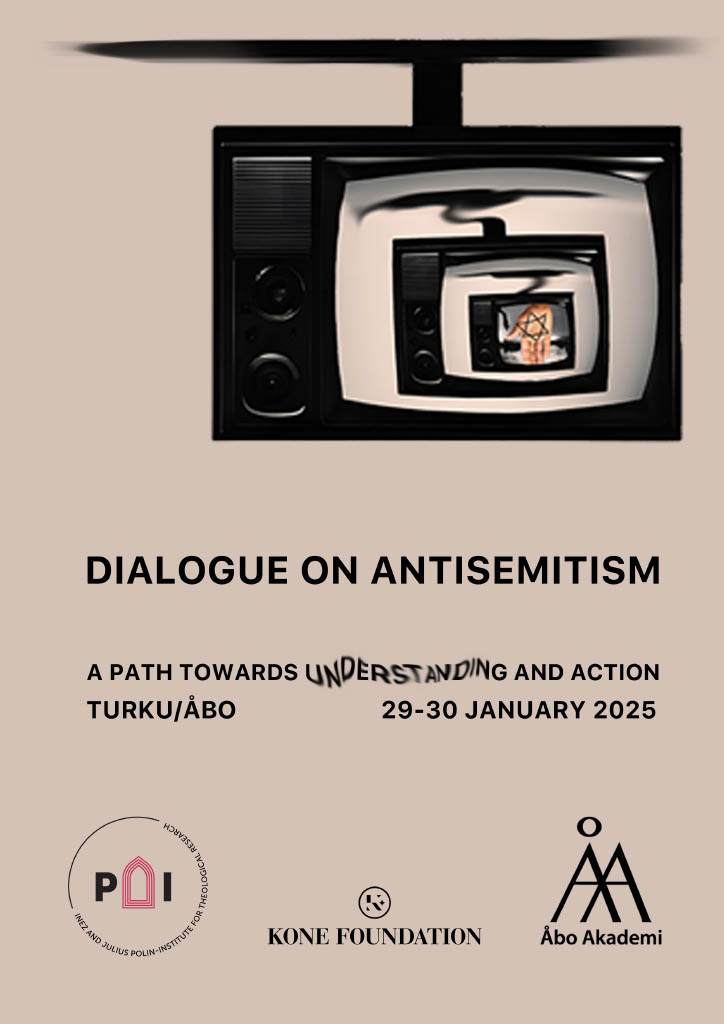
It is our great pleasure to invite you to the first conference in Finland on antisemitism, organized by the Antisemitism Undermining Democracy Project and the Inez and Julius Polin Institute for Theological Research.
In a time where Jewish communities and individuals around the globe encounter with hate, combating and preventing antisemitism is a priority. Actions for combatting antisemitism however cannot be efficiently planned without knowing and understanding the different manifestations of the phenomena in our diverse societies. The objective of this conference therefore is to facilitate the knowledge exchange between researchers and policy makers, and open the dialogue between them as well as the general public in order to increase the possibilities of creating effective counterstrategies against antisemitism.
The conference will take place between the 29– 30 January, 2025 in Åbo (Turku), Finland at the premises of Åbo Akademi University in Finland. The goal of the conference is to promote cross-disciplinary dialogue, and to explore and discuss the phenomena of antisemitism in diverse societies.
We welcome papers that reflect on the social and political implications of antisemitism (both historical and contemporary), including antisemitism in the press, media, and among different groups in diverse societies. We also encourage participants to submit papers connected to antisemitism in historical and contemporary settings, to the effects of antisemitism on education, democracy and democratic values, religious lives of Jewish individuals, as well as papers on proposed methods and good practices in researching as well as in combatting antisemitism.
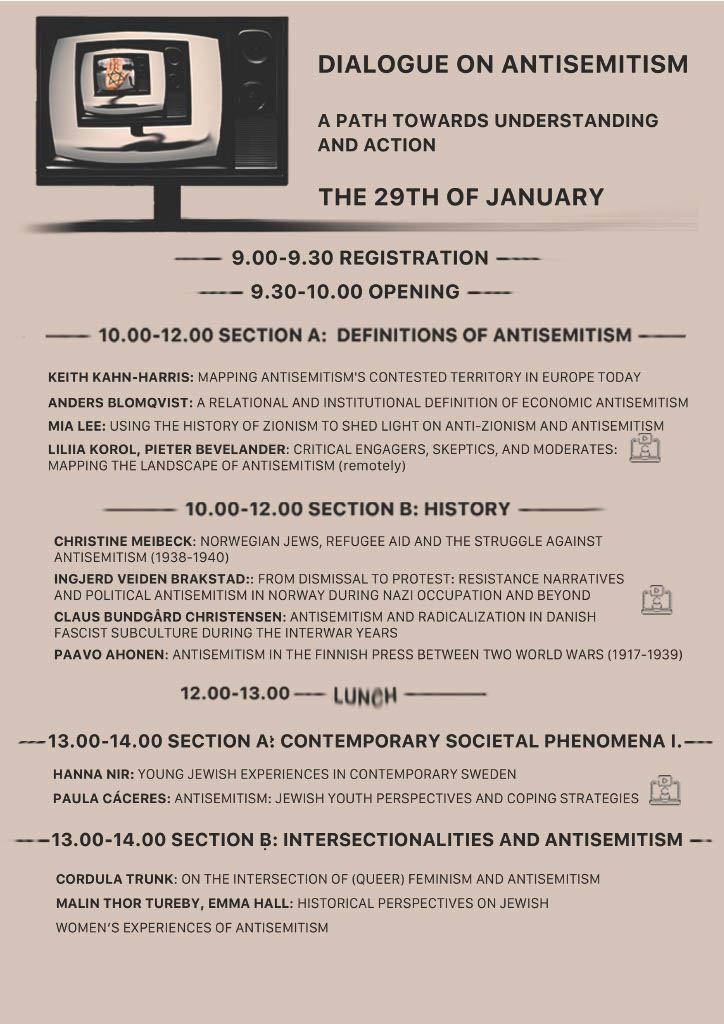
A final programme of the conference will be prepared later, but the invited esteemed keynote speakers have already been confirmed:
Izabella Tabarovsky (Wilson Center) CANCELLED
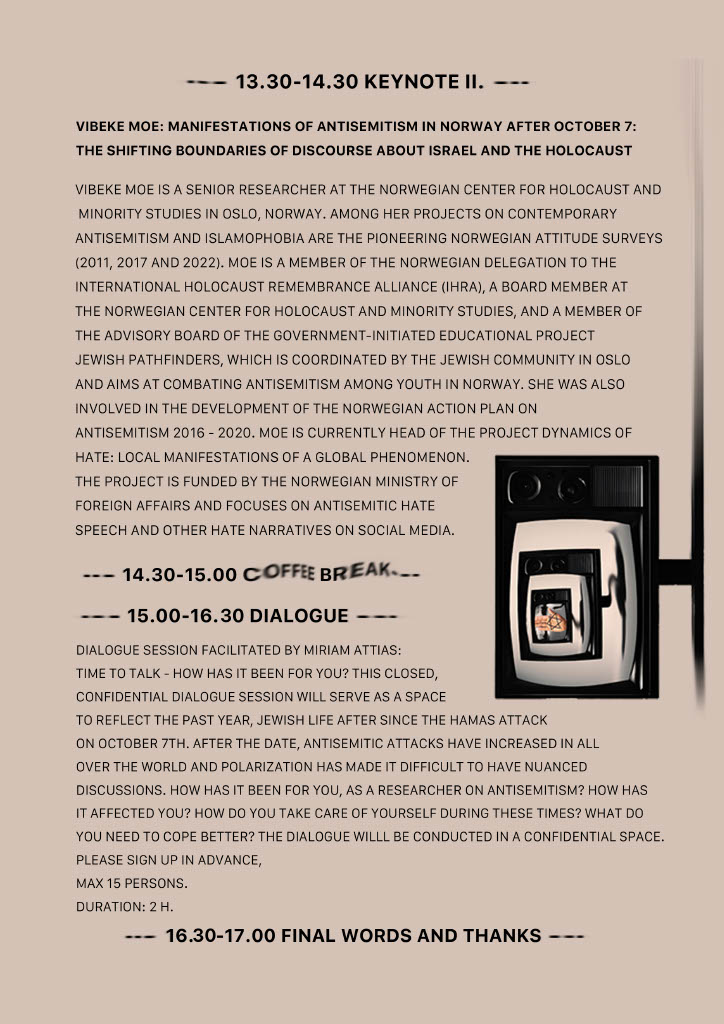
Vibeke Moe (Norwegian Center for Holocaust and Minority Studies)
Please register via this link. If you do not wish to present at the conference but would like to attend, please register under the same link until 14th January. Please note that teachers only register here.
Do you have any questions? Please send them to debunkingantisemitism@abo.fi. The conference is held at Arken, Tehtaankatu 2, Åbo Akademi University in Turku (Åbo), Finland.
We are looking forward to seeing you in Åbo / Turku.
Organising committee:
Mercédesz Czimbalmos, Åbo Akademi University
Dóra Pataricza, Åbo Akademi University
Nóra Varga, Åbo Akademi University


An international conference organized by the Polin Institute of Åbo Akademi University
Espoo, Finland, 27th-30th August 2024
Pentecostalism is one of the most dynamic and influential forms of Christianity in contemporary Africa. It has been variously described as a response to modernity, a postmodern phenomenon itself, a revitalization movement, a return to the fundamental theology embodying the Third person of the Trinity, a source of hope, empowerment, a vehicle of social transformation, a challenge or concession to the postcolonial state, a recalibration of public religion, a power behind spiritual and socio-economic development in Africa today. Pentecostalism also reflects and mirrors the complex and often contradictory interactions between Christianity, African cultures, traditions, identities, and the very idea of the Church as a historic faith community.
This conference, aiming at producing an edited volume, invites contributions that explore the dialectics of Pentecostalism and Christianity in the postcolonial context of Africa. We are interested in papers that address questions such as:
- How does Pentecostalism relate to the historical and contemporary expressions of Christianity in Africa, such as African Instituted Churches, revival movements, mainline denominations, and ecumenical initiatives?
- How does Pentecostalism engage with postcolonial Africa’s political, economic, social, and cultural realities, such as democracy, development, poverty, gender, health, violence, migration, and media?
- How does Pentecostalism articulate and negotiate its identity and mission in relation to other African religious traditions and movements, such as Islam, African traditional religions, new religious movements, and secularism?
- How does Pentecostalism shape and challenge the theological and ethical discourses and practices of African Christianity, such as pneumatology, eschatology, soteriology, ecclesiology, spirituality, morality, and social justice?
This is an interdisciplinary project, and we welcome papers grounded in different disciplines and employing diverse methods and sources. We especially encourage papers based on empirical research and offering critical and constructive insights into the phenomenon of Pentecostalism in Africa.
The deadline for abstract submissions (300 words) is 30 April 2024. The deadline for preliminary papers (drafts) is 31 July 2024, and for full chapters (6000-8000 words, ready for submission to the publisher), it is 30 October 2024.
To register for the conference, please use this link. To submit your abstracts, please use this link. To submit your preliminary paper, please use this link.
The conference will be held at Backby Manor, Espoo, Finland https://www.backby.fi/en/
The conference fee, 580€, covers accommodation and full board during the conference.
Editors of the planned volume:
- Elias K. Bongmba – Rice University
- Martina Björkander – Åbo Akademi University
- Peter White – Stellenbosch University
Program
27th August
5 pm-7 pm Arrivals and dinner
7 pm Welcoming session: working methods, aims
Keynote: Prof Chammah Kaunda: The Charismatization of African Christianity: Challenges and opportunities for mission, theology and ecumenic
8 pm Social evening
28th August
9 am-10:30 am Session 1
Papers presented by Elias Bongmba & Evelyn Mayanja & Devaka Premawardhana
10:30 am -11 am Coffee break
11 am-12:30 pm Session 2
Papers presented by Peter White, Francis Benyah & Itohan Idumwonyi
12:30 pm-2 pm Lunch
2 pm-3 pm Keynote: Prof Nimi Wariboko: Fatigued Sovereignty and Hope: The ”Holy Saturday” of Prosperity Gospel in the African Postcolony
3 pm-3:30 pm Coffee break
3:30 pm-5 pm Session 3
Papers presented by participants through the call of papers
6 pm-7 pm Dinner
8 pm Social evening
29th August
9 am-10:30 am Session 4
Papers presented by participants through the call of papers
10:30 am-11 am Coffee break
11 am-12:30 pm Session 5
Papers presented by participants through the call of papers
12:30 pm-2 pm Lunch
2 pm-3 pm Keynote: Prof Maria Frahm-Arp: Decolonising the Self: Pentecostalism as a framework for self-reformulation and reconstruction in post-colonial South Africa
3 pm-6:30 pm Helsinki sightseeing
6:30 pm-7:30 pm Dinner
30th August
9 am-10:30 am Session 5
Papers presented by Kwabena Asamoah-Gyadu (online) & Mika Vähäkangas & Martina Björkander
10:30 am-11:00 am Coffee break
11 am-12:30 am Publishing workshop & closing session
12:30 pm Lunch and departure
Religious Heritage and Change in the North
Historical, Contemporary and Comparative Perspectives
Research conference in Turku/Åbo, 10-11 November 2022
This conference is organized jointly by the research network Religious History of the North (REHN) at Umeå University, and the research project Changing Spaces: Ritual Buildings, Sacred Objects, and Human Sensemaking at the Polin Institute/Åbo Akademi University.
The conference will offer an arena for scholarly reflection on religious heritage in times of change. We aspire to explore themes and cases, where religion and heritage are challenged, reinterpreted, or even reinforced due to changing realities of for instance social, economic, technical, and environmental character. While heritage has often been pondered as a contemporary concern in relation to the future, this conference also takes an interest in religious heritage and change in the past. We view the concept of religious heritage in a broad sense, including material and immaterial heritage, such as buildings, objects, or traditions being used by living religious communities, or that have lost religious meaning. In the past decades, many religious sites, objects, and even practices have been reframed primarily as heritage. In some cases, redundant Christian churches have been sold, sacred objects have been musealised, and religious customs have become folk festivities – implying perhaps a tension between religion and heritage. In other cases, deep interaction between heritage and practiced religion has enabled the continued existence of religious traditions or the emergence of new, alternative practises. The conference has a particular interest in religious heritage in northern Europe but also welcomes other, contrasting and comparative, contributions.
Below, we provide a list of potential sub-themes, but we also welcome other topics with relevance to the conference theme.
- Converting, rebuilding, or reusing religious heritage
- Religious communities and heritagisation
- The politics of religious heritage
- Indigenous and postcolonial perspectives
- Religious heritage and changing landscapes
- Religious heritage in museums
Please send your paper proposal (with 150-200 words) before 1 May 2022 to religiousheritage@abo.fi. Letters of acceptance will be posted no later than 31 May 2022.
The conference is held at Åbo Akademi University in Turku (Åbo), Finland. Should the Covid pandemic prevent an on-site conference, we may opt for a hybrid alternative. After the conference, the presenters will be given an opportunity to have their papers peer reviewed, and – if approved – published in an edited volume. A conference fee of 40€ will be collected to cover costs for a conference dinner, coffee breaks, and running costs. Lastly, keynote speakers will be announced towards the end of February. All conference updates will be posted on the conference webpage that will be announced in a few days.
Organising committee:
Jakob Dahlbacka, Åbo Akademi University
Stefan Gelfgren, Umeå University
Kim Groop, Åbo Akademi University
Daniel Lindmark, Umeå University
Carola Nordbäck, Åbo Akademi University and Mid Sweden University


Religious Heritage and Change in the North
Historical, Contemporary and Comparative Perspectives
Research conference in Turku/Åbo, 10-11 November 2022
This conference is organized jointly by the research network Religious History of the North (REHN) at Umeå University, and the research project Changing Spaces: Ritual Buildings, Sacred Objects, and Human Sensemaking at the Polin Institute/Åbo Akademi University.
The conference will offer an arena for scholarly reflection on religious heritage in times of change. We aspire to explore themes and cases, where religion and heritage are challenged, reinterpreted, or even reinforced due to changing realities of for instance social, economic, technical, and environmental character. While heritage has often been pondered as a contemporary concern in relation to the future, this conference also takes an interest in religious heritage and change in the past. We view the concept of religious heritage in a broad sense, including material and immaterial heritage, such as buildings, objects, or traditions being used by living religious communities, or that have lost religious meaning. In the past decades, many religious sites, objects, and even practices have been reframed primarily as heritage. In some cases, redundant Christian churches have been sold, sacred objects have been musealised, and religious customs have become folk festivities – implying perhaps a tension between religion and heritage. In other cases, deep interaction between heritage and practiced religion has enabled the continued existence of religious traditions or the emergence of new, alternative practises. The conference has a particular interest in religious heritage in northern Europe but also welcomes other, contrasting and comparative, contributions.
Below, we provide a list of potential sub-themes, but we also welcome other topics with relevance to the conference theme.
- Converting, rebuilding, or reusing religious heritage
- Religious communities and heritagisation
- The politics of religious heritage
- Indigenous and postcolonial perspectives
- Religious heritage and changing landscapes
- Religious heritage in museums
Please send your paper proposal (with 150-200 words) before 1 May 2022 to religiousheritage@abo.fi. Letters of acceptance will be posted no later than 31 May 2022.
The conference will be held at Åbo Akademi University in Turku (Åbo), Finland. Should the Covid pandemic prevent an on-site conference, we may opt for a hybrid conference. After the conference, the presenters will be given an opportunity to have their papers peer reviewed, and – if approved – published in an edited volume. A conference fee of 40€ will be collected to cover costs for a conference dinner, coffee breaks, and running costs. For updated information about the conference, please visit the conference webpage [***].
Organising committee
Jakob Dahlbacka, Åbo Akademi University
Stefan Gelfgren, Umeå University
Kim Groop, Åbo Akademi University
Daniel Lindmark, Umeå University
Carola Nordbäck, Åbo Akademi University and Mid Sweden University
10.03.2026 | Conference
Jewish Studies in the Nordic Countries: Junior Researcher Conference 9-10 November, 2026
Jewish Studies in the Nordic CountriesJunior Researcher Conference Turku, Finland 9-10 November, 2026 This is a conference for scholars in all disciplines whose research can be classified as “Jewish Studies”. It is especially geared towards junior researchers (PhD students and recent PhD graduates). Senior scholars are also very welcome, but we reserve the option of […]
16.10.2025 | Conference
Political Theologies of Constitutions, the Rule of Law, and the Common Good, CFP deadline 6 December 2025
Political Theologies of Constitutions, the Rule of Law, and the Common Good 23-24 April 2026University of Cambridge The constitution functions not only as a legal framework but also as a symbolic and practical foundation for societal life. This brings to the fore the role of constitutional values and principles as shared reference points. Constitutions may […]
16.01.2025 | Conference
CFP: Rethinking the holy materiality: bones and other “stuff”, with and without reliquaries (the Middles Ages and Beyond), deadline March 1, 2025
A workshop Rethinking the holy materiality: bones and other “stuff”, with and without reliquaries (the Middles Ages and Beyond) September 10–11, 2025 Venue: University of Turku and Åbo Akademi University, Turku, Finland Call for Papers While much has been published on relics, their understanding remains restricted and inflexible because of the prevalent definitions of the […]

04.12.2024 | Conference
REVIVAL MOVEMENTS IN WORLD CHRISTIANITY: KEY THEMES AND METHODOLOGICAL ISSUES
Revival Movements in World Christianity: Key Themes and Methodological Issues An international conference organised by the Polin Institute of Åbo Akademi University in collaboration with the Oxford Centre of Mission Studies, UK. Helsinki, Finland, 1-4 September 2025 The term revival has been loosely used to refer to various spiritual awakening movements in the history of […]

31.10.2024 | Conference
POLITICAL THEOLOGIES OF A DEMOCRATIC COMMON LIFE, CFP DEADLINE 30 NOVEMBER, 2024
Political Theologies of a Democratic Common Life 24-26 March 2025 New College, University of Oxford Event Description: Religion has a complex role in shaping our political landscape, with the power to either fuel division or serve as a resource for a democratic common life. The fifth Political Theologies conference gathers scholars and practitioners to discuss how […]

07.06.2024 | Conference
Dialogue on Antisemitism: A Path Towards Understanding and Action
Historical, Contemporary, and Comparative Perspectives Research conference in Arken, Tehtaankatu 2, Åbo/Turku, 29-30 January 2025 PROGRAM AND ABSTRACTS It is our great pleasure to invite you to the first conference in Finland on antisemitism, organized by the Antisemitism Undermining Democracy Project and the Inez and Julius Polin Institute for Theological Research. In a time where […]

14.03.2024 | Conference
PENTECOSTALISM AND THE DIALECTICS OF CHRISTIANITY IN THE POSTCOLONY
An international conference organized by the Polin Institute of Åbo Akademi University Espoo, Finland, 27th-30th August 2024 Pentecostalism is one of the most dynamic and influential forms of Christianity in contemporary Africa. It has been variously described as a response to modernity, a postmodern phenomenon itself, a revitalization movement, a return to the fundamental theology embodying […]
28.03.2022 | Conference
Call For Papers Religious Heritage and Change in the North
Religious Heritage and Change in the North Historical, Contemporary and Comparative Perspectives Research conference in Turku/Åbo, 10-11 November 2022 This conference is organized jointly by the research network Religious History of the North (REHN) at Umeå University, and the research project Changing Spaces: Ritual Buildings, Sacred Objects, and Human Sensemaking at the Polin Institute/Åbo Akademi University. The conference […]

07.02.2022 | Conference
Call for Papers Religious Heritage and Change in the North
Religious Heritage and Change in the North Historical, Contemporary and Comparative Perspectives Research conference in Turku/Åbo, 10-11 November 2022 This conference is organized jointly by the research network Religious History of the North (REHN) at Umeå University, and the research project Changing Spaces: Ritual Buildings, Sacred Objects, and Human Sensemaking at the Polin […]